On November 19, 2026, CEN and CENELEC published EN 40000-1-1 and EN 40000-1-2, the first European standards built to support the EU Cyber Resilience Act (CRA) (CEN-CENELEC). The CRA has told manufacturers what a connected product must achieve since it entered into force on December 10, 2024 (European Commission). It never told them how to show it. These two standards start to answer that question. Their answer is a risk-based lifecycle, and they stop short of telling you which controls to build.
My argument is simple. Products that you place on the EU market after December 11, 2027 are in design today. The controls that make them defensible under the CRA are architecture decisions: device identity, signed firmware and updates, secure boot, and keys and certificates that last as long as the support period. Your team cannot bolt those on at certification time.
What shipped on November 19
CEN and CENELEC published two standards (CEN-CENELEC):
- EN 40000-1-1, Vocabulary. It sets common terms and definitions for the whole EN 40000 series.
- EN 40000-1-2, Principles, product risk management, and lifecycle activities. It sets a common way to identify, assess and manage cybersecurity risk “from the earliest design decisions through development, production, maintenance and, ultimately, the end of the product’s support period and decommissioning.”
CEN-CLC/JTC 13/WG 9 wrote both standards, with NEN holding the secretariat. More than 450 committee members from 28 national standardization organizations and 17 liaison organizations took part (CEN-CENELEC). The two documents are among the first deliverables under the Commission’s standardisation request M/606, which asks for 41 standards in total, both horizontal and product-specific (European Commission). You buy them through your national standards body, on that body’s publication schedule.
What the standards do, and what they do not
The CRA states its essential requirements in Annex I, and they read as outcomes. A product must be “made available on the market with a secure by default configuration.” It must “ensure that vulnerabilities can be addressed through security updates.” It must protect the integrity of “commands, programs and configuration against any manipulation or modification not authorised by the user” (Regulation (EU) 2024/2847). An engineering team cannot build to an outcome. It builds to a method.
Harmonised standards supply the method, and some of them carry legal weight. Article 27(1) says products that conform to harmonised standards “the references of which have been published in the Official Journal of the European Union” are presumed to conform with the Annex I requirements “covered by those standards” (EUR-Lex). Both conditions matter: the standard must be cited in the Official Journal, and the presumption reaches only the requirements that standard covers. The weight grows for higher-risk products. A manufacturer of an important product in class I can use self-assessment only if it applied harmonised standards, common specifications or a European certification scheme; otherwise a notified body must assess the product. Important class II and critical products need third-party assessment, or a European certification scheme where one applies (European Commission).
EN 40000-1-2 is not that kind of standard. Three points keep this honest.
It is a framework, not a requirements list. CEN-CENELEC describes it as “a common framework on which more detailed cybersecurity requirements and measures can be built” (CEN-CENELEC). Sarah Fluchs, CTO of admeritia and a member of the Commission’s CRA Expert Group, sorts harmonised standards into three types. She puts EN 40000-1-2 in Type A, the horizontal frameworks, because it holds “generic, overarching principles and not specific requirements.” She adds that Type A standards never carry a presumption of conformity, “as they are not specific enough” (Fluchs, October 27, 2026).
It is not cited in the Official Journal, and it may never be. The CEN-CENELEC announcement does not mention a citation. An independent tracker kept by Piotr Polak lists EN 40000-1-1 and EN 40000-1-2 as published with the tag “No OJ citation expected,” and reports that no CRA harmonised standard is cited in the Official Journal yet (CRA Standards Tracker, last checked by its author on November 19, 2026). I have not found a Commission statement that confirms this, so treat it as a well-informed secondary reading and search EUR-Lex for an implementing decision citing standards under Regulation (EU) 2024/2847 before you rely on it. On that reading, applying EN 40000-1-2 does not make a product compliant, and it does not give a presumption of conformity.
The risk assessment stays yours. Article 13(2) says manufacturers “shall undertake an assessment of the cybersecurity risks associated with a product with digital elements.” Article 13(3) says the assessment “shall be documented and updated as appropriate during a support period,” and must show whether and how each Annex I Part I(2) requirement applies to the product (EUR-Lex). The Commission’s guidance on applying the CRA, published in the Official Journal on November 17, 2026, removes any doubt: “The manufacturer is always required to carry out a risk assessment pursuant to Article 13(2) and should consequently check whether implementing a harmonised standard covers all risks associated with the product with digital elements” (Commission guidance C/2026/6013, paragraph 150). A cited standard can help you show conformity. It does not replace the assessment. Fluchs makes the same point from the engineering side: defining security requirements “is not a matter of checking items off a fixed list” (Fluchs).
The two standards still matter, because every later CRA standard will build on them. CEN-CENELEC says the EN 40000-1-2 framework supports the coming standards on vulnerability handling, generic security requirements and specific product categories (CEN-CENELEC). Teams that learn the vocabulary and the risk method now will read the next wave faster.
The lifecycle, mapped to the device trust layer
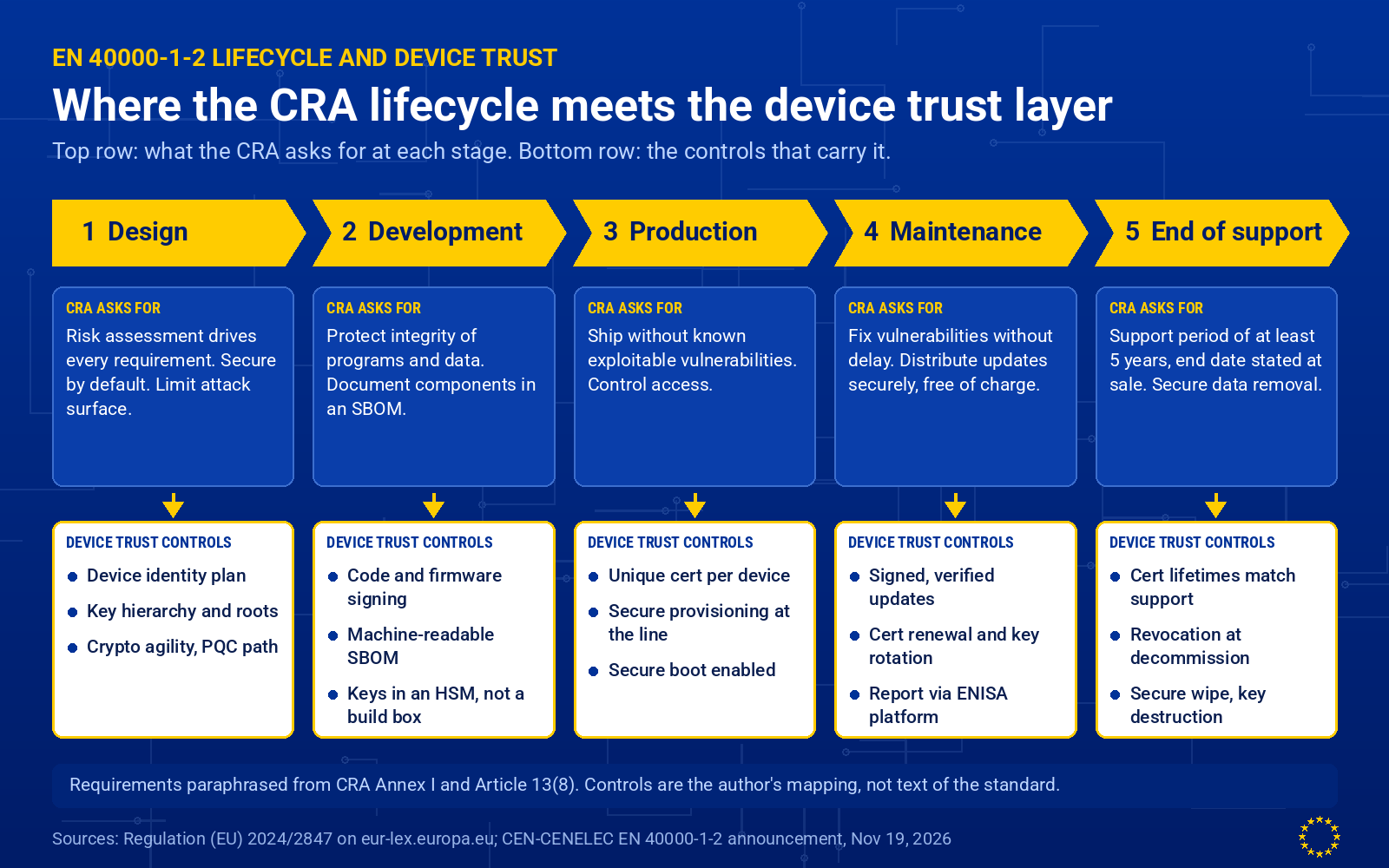
EN 40000-1-2 treats security as a property you manage from design through decommissioning, not a test you pass before launch (CEN-CENELEC). The table below maps each stage to what the CRA text asks for and to the device trust controls I would put in place. The middle column paraphrases Annex I and Article 13 of the Regulation (EUR-Lex). The right column is my mapping, not text from the standard. The stage names follow CEN-CENELEC’s public description of EN 40000-1-2, not its clause structure, and the standard does not prescribe any of the controls in the right column.
| Lifecycle stage | What the CRA asks for | Device trust controls |
|---|---|---|
| Design | A risk assessment that drives every requirement; secure by default; limited attack surface | Device identity plan, key hierarchy and roots, crypto agility with a post-quantum path |
| Development | Integrity of programs, commands and configuration; a machine-readable software bill of materials (SBOM) | Code and firmware signing, SBOM generated per build, signing keys held in an HSM |
| Production | No known exploitable vulnerabilities at release; access control through authentication and identity management | A unique certificate per device, secure provisioning on the line, secure boot turned on |
| Maintenance | Vulnerabilities fixed without delay; updates distributed securely and free of charge | Signed and verified updates, certificate renewal and key rotation, a tested reporting path |
| End of support | A support period of at least five years (or the expected use time if shorter), with the end date stated at purchase; secure removal of user data | Certificate lifetimes that match the support period, revocation at decommissioning, key destruction |
Three rows deserve more than a table cell.
The signing key is the product. Annex I asks manufacturers to protect integrity and to “provide for mechanisms to securely distribute updates” (EUR-Lex). In practice that means firmware and updates signed by the manufacturer and verified on the device by a secure boot chain. That design moves the risk onto one asset: the signing key. Whoever holds the key can ship an update that every device in the field will trust. A CRA program that documents secure updates but leaves the signing key on a build server has documented the wrong thing.
The support period sets your certificate math. Article 13(8) says “the support period shall be at least five years,” or the expected use time if the product will be in use for less (EUR-Lex). The manufacturer must state the end date, month and year, at the time of purchase (European Commission). Every device certificate, intermediate CA and trust anchor on that product now needs a validity and rollover plan that covers that date. If a device certificate expires before support ends, or the root cannot be rotated in the field, the manufacturer has a support promise it cannot keep. Five years is also a floor. The Commission’s guidance says it should not be treated as the default, and that products expected to be in use for longer should have longer support periods (Commission guidance C/2026/6013, paragraph 126). For industrial devices that can mean certificate and root planning well past five years.
Crypto agility is a lifecycle requirement. A product placed on the market in 2028 with a five-year minimum support period can stay in support into 2033. Annex I asks manufacturers to protect confidentiality with “state of the art mechanisms” (EUR-Lex). The state of the art is already moving: NIST published FIPS 204, its module-lattice-based digital signature standard (ML-DSA), on August 13, 2024 (NIST). My reading, not a legal interpretation: a device that cannot change its signature algorithm or trust anchors over a five-year-plus support period carries a risk the CRA risk assessment should name. Plan for algorithm and root updates now, even if you ship classical cryptography first.
Post-quantum: secure boot, dual roots and firmware signing
A device that ships in 2028 and stays in support into 2033 will verify its firmware with whatever its boot chain accepts on day one. Post-quantum planning for devices starts there, not in the TLS stack. Three decisions matter.
Secure boot. The first verifier in the chain usually sits in boot ROM and one-time-programmable fuses, so nobody can patch it later. Ask your silicon vendor two questions before you lock a design: which signature algorithms the boot ROM verifies, and how many root key slots it offers. Whether a given part verifies ML-DSA or LMS in ROM depends on the vendor and the part, so check the SoC’s secure boot reference manual or ask the vendor’s field engineer. If it does not, reserve a spare root key slot and plan a first-stage bootloader that verifies a post-quantum signature, so that only the ROM step stays classical.
Dual roots of trust. You can carry classical and post-quantum trust side by side in two ways.
- Parallel chains: a classical root and a post-quantum root, each with its own intermediates, and every image signed twice. The device checks both signatures, or the one its boot code supports. Each chain stays simple, but you run two hierarchies and ship two signatures.
- Composite signatures: one certificate and one signature that pair ML-DSA with RSA, ECDSA or EdDSA, and verify only when both parts verify. RFC 10073 defines composite ML-DSA for X.509 certificates (IETF), and RFC 10082 defines its use in the Cryptographic Message Syntax, the format many firmware signing schemes use (IETF). Both are Proposed Standards published in November 2026. They are weeks old, so ask your HSM, signing service and verifier library vendors which composite combinations they support before you design around one. Support differs by vendor and I have not surveyed it, so check each vendor’s release notes.
Either way, size flash, boot time and update packages for the new keys. FIPS 204 lists ML-DSA signatures of 2,420 to 4,627 bytes and public keys of 1,312 to 2,592 bytes, depending on the security level (NIST). A bootloader that budgeted for a 64-byte ECDSA signature will not fit them without a redesign.
Firmware signing with PQC. Two families fit.
- LMS and XMSS: stateful hash-based signatures that NIST approved for this use in SP 800-208 (NIST). They rest only on hash functions, and each key can sign only a fixed number of messages. The signer must never reuse a one-time key, so state management is the hard part. NSA’s CNSA 2.0 guidance recommends LMS with SHA-256/192 for software and firmware signing and says you “must meet all the requirements of SP 800-208, including the need to manage state and implement signing in hardware” (NSA). In practice that means an HSM that tracks state, not a build server. There is a second catch. SP 800-208 requires hardware modules “that do not allow secret keying material to be exported, even in encrypted form,” so you cannot back the key up the usual way. NIST’s answer is to spread the key across several modules at the first key ceremony: “all of the bottom-level keys should be generated up front” (NIST). Decide how many HSMs and sites you need before you sign the first image, because you cannot add a backup later.
- ML-DSA: stateless and general purpose (FIPS 204). It suits update servers that sign often, and hierarchies that also issue device certificates.
I am not claiming the CRA requires post-quantum cryptography. The argument rests on the risk assessment and the length of the support period. CNSA 2.0 sets a clock for US National Security Systems. For software and firmware signing, NSA says to “begin transitioning immediately, support and prefer CNSA 2.0 by 2025, and exclusively use CNSA 2.0 by 2030” (NSA). That clock does not apply to the CRA. It does show where large buyers, and the suppliers who sell to them, are heading. My reading, not a legal interpretation: a product in support until 2033 that cannot move its signing to a post-quantum algorithm will find it hard to call its integrity protection “state of the art” for the whole support period.
What to do now:
- Ask your SoC vendor what the boot ROM verifies and how many root key slots it has.
- Pick a firmware signing scheme: LMS or XMSS in a state-managing HSM, ML-DSA, or a classical and post-quantum pair.
- Design the root hierarchy for two algorithms, as parallel chains or composite certificates.
- If you choose LMS or XMSS, plan the key ceremony and the number of HSMs before the first signature, because the key cannot be exported.
- Budget flash, boot time and update size for post-quantum keys and signatures.
- Write the algorithm and root rollover plan into your risk assessment and technical documentation, tied to the support period.
Controlling AI in connected devices
More connected products now run a model on the device or call one from it: a vision model in a camera, an anomaly detector in a controller, an agent that changes settings in a building system. My reading, not a legal interpretation: the model, its runtime and the code that calls it are software inside a product with digital elements, so the Annex I requirements apply to them like any other component.
The CRA links to the AI Act directly. Article 12 says a product with digital elements that is also a high-risk AI system is deemed to meet the AI Act’s cybersecurity requirements in Article 15 when it meets Annex I Parts I and II and the EU declaration of conformity shows it (EUR-Lex). Article 15(5) of the AI Act names the attacks to control for: “data poisoning,” “model poisoning,” “adversarial examples or model evasion,” “confidentiality attacks or model flaws” (EUR-Lex).
The device trust layer answers most of that list. The Annex I references below come from the CRA text (EUR-Lex); mapping them to AI is my reading.
- Sign the model. Treat model weights and configuration like firmware. Sign every model and model update, verify the signature before the runtime loads it, and refuse an unsigned or older model. Annex I Part I(2)(f) asks you to protect the integrity of “commands, programs and configuration,” and Part II(7) asks for mechanisms to securely distribute updates. Signing is your control against model poisoning in the supply chain.
- Put the model in the SBOM. Part II(1) asks for a software bill of materials “covering at the very least the top-level dependencies.” List each model, its version and hash, and its pre-trained components, so you can trace a model flaw the way you trace a library vulnerability.
- Give the device and the agent an identity. Part I(2)(d) asks for protection from unauthorised access through “authentication, identity or access management systems.” Give each device a unique certificate. Give any agent that calls tools or cloud services its own credential, scoped to what it may do, and use mutual TLS so both ends know who is talking.
- Limit what the AI can touch. Part I(2)(j) asks you to limit attack surfaces. Run the model with least privilege and let it act only through an allow-list of commands. A model that can change a setpoint should not also be able to change its own update server.
- Keep data minimal and protected. Part I(2)(g) asks you to process only the data the product needs, and Part I(2)(e) asks for confidentiality through state of the art encryption. Encrypt model inputs and outputs that leave the device.
- Log what the AI does. Part I(2)(l) asks for recording and monitoring of relevant internal activity, with an opt-out for the user. Log the model version, the signature check result and every action the agent takes, and protect the logs so they hold up later.
- Handle model flaws as vulnerabilities. My reading: an actively exploited weakness in an on-device model, such as an input that makes the device act unsafely, falls under the same 24-hour and 72-hour reporting clocks as any other actively exploited vulnerability. Fix it with a signed model update, and keep a signed path to roll back or revoke a model, so you can pull a bad model from the field as fast as a bad firmware image.
The timeline you are working against
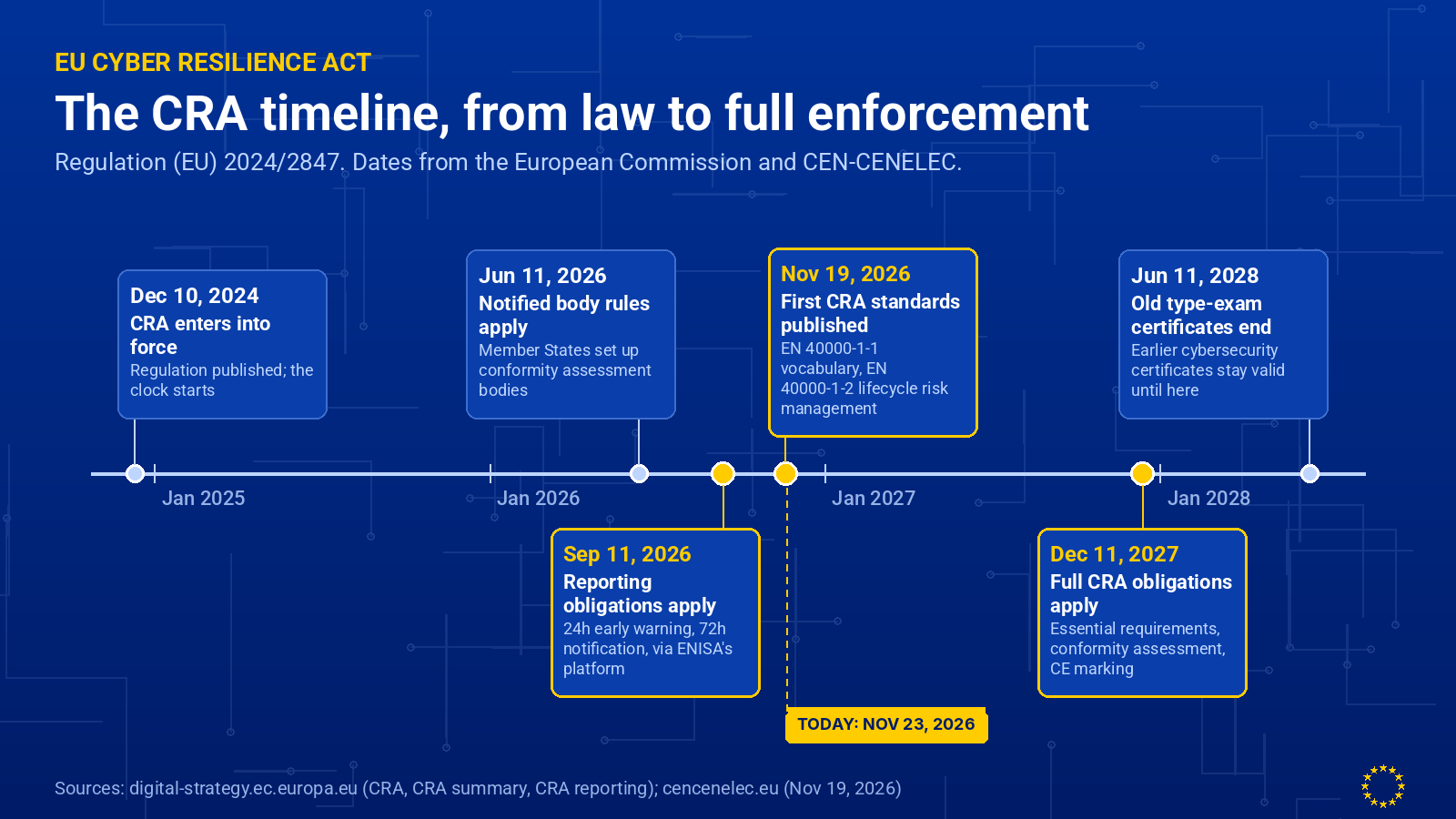
The European Commission sets these dates (CRA, CRA summary, reporting obligations):
- December 10, 2024. The CRA entered into force.
- June 11, 2026. Chapter IV, the rules for notifying conformity assessment bodies, applies.
- September 11, 2026. Reporting obligations apply. Manufacturers send an early warning within 24 hours of becoming aware of an actively exploited vulnerability or severe incident, a notification within 72 hours, and a final report within 14 days of a fix (vulnerabilities) or one month (incidents). Reports go through ENISA’s Single Reporting Platform.
- November 19, 2026. CEN and CENELEC published EN 40000-1-1 and EN 40000-1-2 (CEN-CENELEC).
- December 11, 2027. The main obligations apply: essential requirements, conformity assessment and CE marking.
- June 11, 2028. Existing EU type-examination certificates covering cybersecurity stay valid until this date, unless they expire first.
Two details in the Commission’s summary change how you should plan. Reporting already covers every product made available on the EU market, including products placed there before December 11, 2027. And a product placed on the market before December 11, 2027 falls under the full CRA from that date only if it undergoes a substantial modification (European Commission). Your installed base is in scope for reporting today. Your next major firmware release may bring a legacy product into full scope.
As of publication on November 23, 2026, reporting has been live for more than ten weeks and full application is a little over twelve months away. I covered the reporting duties in detail in The 24-Hour Clock Is Already Running.
What to do in the next 90 days
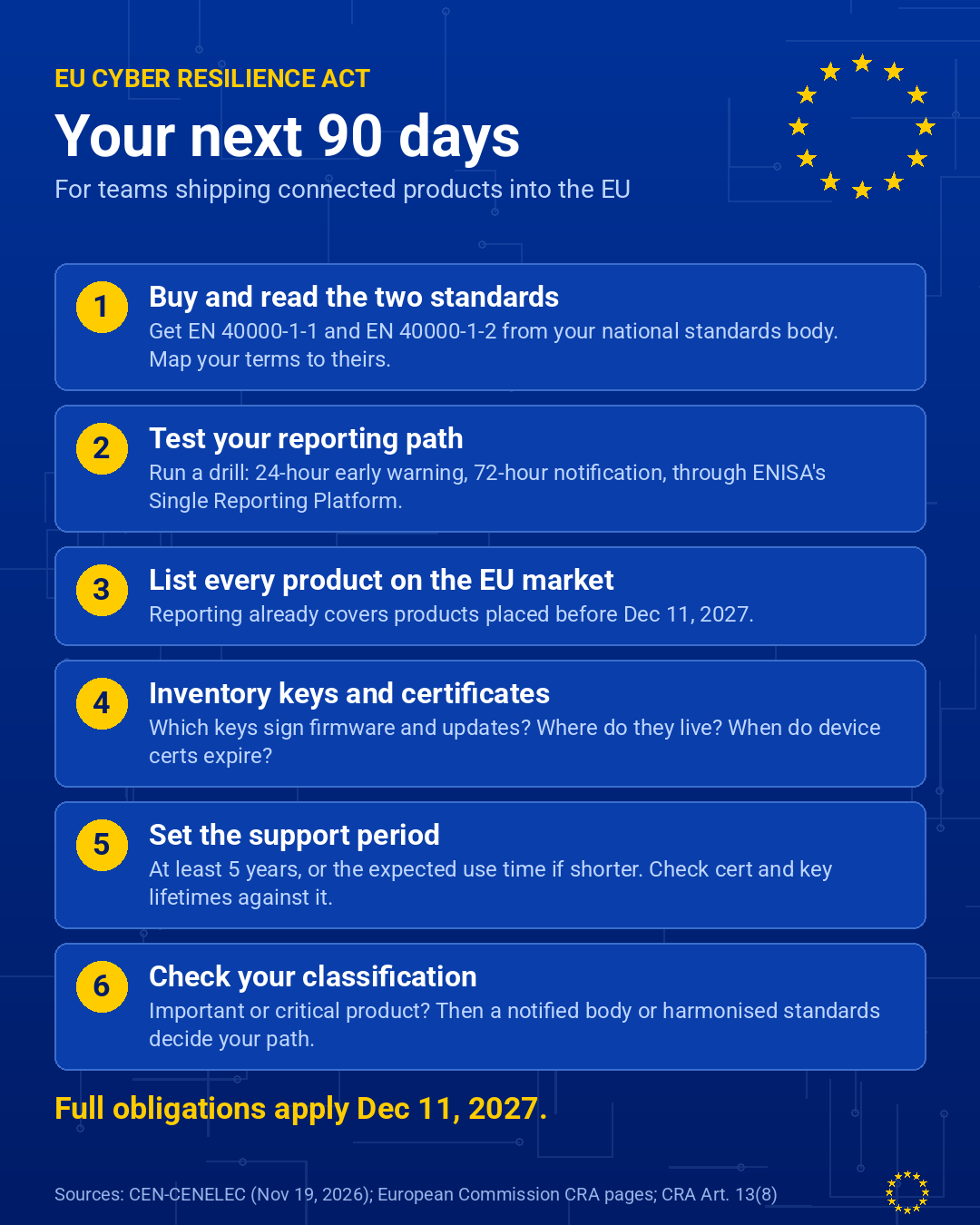
- Buy and read the two standards. Get EN 40000-1-1 and EN 40000-1-2 from your national standards body. Map your internal security terms to theirs, so your technical documentation speaks the same language as your assessor. Then use EN 40000-1-2 to structure the product risk assessment that Article 13 requires, and name one owner for it. Reading the standard is not the deliverable. The documented risk assessment is.
- Test your reporting path. Run a tabletop drill against the 24-hour and 72-hour clocks, end to end through ENISA’s Single Reporting Platform. ENISA publishes guidance, FAQs and training material for the platform (European Commission).
- List every product on the EU market. Reporting applies to products already on the market, so the inventory comes first.
- Inventory your keys and certificates. For each product line: which keys sign firmware and updates, where those keys live, who can use them, and when device certificates and intermediates expire.
- Set the support period, then check it against your PKI. Pick the support period per product. Confirm that certificate lifetimes, root rollover and update signing keys all outlast it.
- Check your classification. Find out whether any product falls into the important or critical categories in Annexes III and IV. That answer decides whether harmonised standards or a notified body sit on your critical path, and which product standard you need to watch for an Official Journal citation (European Commission).
What is still coming
CEN and CENELEC say FprEN 40000-1-3 and the first product-specific (vertical) standards will follow “soon,” and horizontal standards on vulnerability handling and generic security requirements are in development (CEN-CENELEC). On November 10, 2026, the Commission amended M/606 to give three more months for all vertical standards and some horizontal ones (European Commission). The Commission also published practical guidance for manufacturers on July 27, 2026 (European Commission), and its guidance on applying the CRA appeared in the Official Journal on November 17, 2026 (C/2026/6013).
The dates below come from Piotr Polak’s tracker, which reads them from the public CEN-CENELEC and ETSI work programs (CRA Standards Tracker, status as of November 11, 2026, last checked by its author on November 19; I read it on November 23). These are planning dates from a secondary source and they move. Each row in the tracker links to the standards body’s own record, which is the place to confirm them.
- prEN 40000-1-3, vulnerability handling. Submitted for formal vote.
- prEN 40000-1-4, generic security requirements. This is the standard for Annex I Part I(2), the product requirements most device teams are waiting for. Fluchs says it aims to turn the CRA’s vague requirements “into specific, testable objectives” (Fluchs). The draft is complete and publication is planned for June 2027, about six months before full application. The tracker tags it “No OJ citation expected” as well.
- EN IEC 62443-4-1 and 4-2, CRA editions. For industrial products, the specifics arrive here. Fluchs writes that both are “planned for publication in late January 2027” (Fluchs). The tracker shows formal votes planned for February 23 and February 8, 2027. The two sources disagree and I have not been able to settle it, so treat the first quarter of 2027 as the window and check the CENELEC records.
- Product standards close to device trust. EN 304 623 on boot managers has final approval planned for January 11, 2027. EN 304 624 on public key infrastructure and digital certificate issuance software has final approval planned for February 11, 2027. prEN 40001-3 on microprocessors and microcontrollers with security-related functionalities is still at the enquiry stage.
Read that schedule as a warning. The standards that will matter most for your specific product are still in drafting or voting, their deadlines just moved later, and none of them gives a presumption of conformity until the Official Journal cites it. A team that waits for the full set before it starts will start with less time than it has today. The work you can do without them is the work Article 13 already requires: the risk assessment and the architecture decisions that follow from it.
Build the trust layer now
The CRA asks manufacturers to keep a product secure from its first design decision to its last day of support. EN 40000-1-2 now gives that lifecycle a common framework. It does not make the design decisions for you. The parts of the lifecycle that last longest, and cost most to change later, are the trust anchors: device identity, signing keys, secure boot and the certificates that tie them together.
If your 2027 products are in design today, they are CRA products. Build the trust layer in now, not at certification time.
Sources
- CEN-CENELEC, “CRA Milestone Unlocked: First European standards supporting CRA are now available!” (Nov 19, 2026): https://www.cencenelec.eu/news-events/news/2026/en-in-the-spotlight/2026-11-19-cra-standards-en-40000-1-1-and-en-40000-1-2/
- European Commission, Cyber Resilience Act: https://digital-strategy.ec.europa.eu/en/policies/cyber-resilience-act
- European Commission, CRA summary of the legislative text: https://digital-strategy.ec.europa.eu/en/policies/cra-summary
- European Commission, CRA reporting obligations: https://digital-strategy.ec.europa.eu/en/policies/cra-reporting
- European Commission, Commission guidance on the application of Regulation (EU) 2024/2847 (Cyber Resilience Act), C/2026/6013 (Official Journal, Nov 17, 2026): https://eur-lex.europa.eu/legal-content/EN/TXT/?uri=OJ:C_202606013
- European Commission, CRA standardisation: https://digital-strategy.ec.europa.eu/en/policies/cra-standardisation
- Regulation (EU) 2024/2847, Official Journal text (Annex I, Articles 12, 13, 27 and 32): https://eur-lex.europa.eu/legal-content/EN/TXT/HTML/?uri=OJ:L_202402847
- Regulation (EU) 2024/1689 (AI Act), Official Journal text (Article 15): https://eur-lex.europa.eu/legal-content/EN/TXT/HTML/?uri=OJ:L_202401689
- NIST, FIPS 204, Module-Lattice-Based Digital Signature Standard (Aug 13, 2024): https://csrc.nist.gov/pubs/fips/204/final (key and signature sizes: https://nvlpubs.nist.gov/nistpubs/FIPS/NIST.FIPS.204.pdf)
- NIST, SP 800-208, Recommendation for Stateful Hash-Based Signature Schemes (Oct 2020): https://csrc.nist.gov/pubs/sp/800/208/final (full text: https://nvlpubs.nist.gov/nistpubs/SpecialPublications/NIST.SP.800-208.pdf)
- NSA, Cybersecurity Advisory, The Commercial National Security Algorithm Suite 2.0 (CNSA 2.0): https://media.defense.gov/2025/May/30/2003728741/-1/-1/0/CSA_CNSA_2.0_ALGORITHMS.PDF
- IETF, RFC 10082, Composite ML-DSA for Use in the Cryptographic Message Syntax (CMS): https://datatracker.ietf.org/doc/rfc10082/
- IETF, RFC 10073, Composite ML-DSA for Use in X.509 Public Key Infrastructure (Nov 2026; formerly draft-ietf-lamps-pq-composite-sigs): https://datatracker.ietf.org/doc/rfc10073/
- Sarah Fluchs, “How IEC 62443 supports manufacturers implementing the Cyber Resilience Act (CRA)” (Oct 27, 2026): https://fluchsfriction.medium.com/how-iec-62443-supports-manufacturers-implementing-the-cyber-resilience-act-cra-31ea8f02940a
- Piotr Polak, CRA Standards Tracker (status as of Nov 11, 2026; last checked by its author Nov 19, 2026; read Nov 23, 2026): https://www.piotrpolak.com/cra/standards/