
Disclosure: I am Regional Field CTO at DigiCert, a certificate authority that competes with eMudhra and Sectigo. This is my personal analysis of public evidence. The views are my own.
TL;DR
Eight keys meant to vouch for websites and software publishers were weak enough to recover. Unprotected software could accept fake website or publisher identities. Update browsers, operating systems and apps; enterprises must check their applications, not just browsers. Downloads since October 17 are not automatically unsafe. The wider lesson: one compromised trusted issuer can put unrelated services at risk.
When you open your bank’s website or install an update, your software has to decide whom to trust. Encryption alone cannot make that decision. An encrypted connection to an impostor can still deliver your password to the wrong person.
Certificates help connect an identity to a public key. A certificate authority, or CA, vouches for that connection. The recent failure involved eMudhra, the company behind the emSign public CA service1.
Why one weak link matters
Your software accepts a collection of trusted authorities. A root is one of its starting points. An intermediate CA receives authority to issue certificates beneath it. A website or software publisher then uses a certificate to establish its identity.
Trust is only as strong as the weakest issuer your software will accept for that purpose. The public Web relies on many organizations vouching for identities. That is its federated trust model: the authorities are separate, but their decisions are accepted across a shared system.
One compromised issuer can undermine authentication far beyond its own customers. An attacker may impersonate a website even when the real website uses a different CA. The attacker does not have to compromise every authority. One accepted route to trust may be enough.
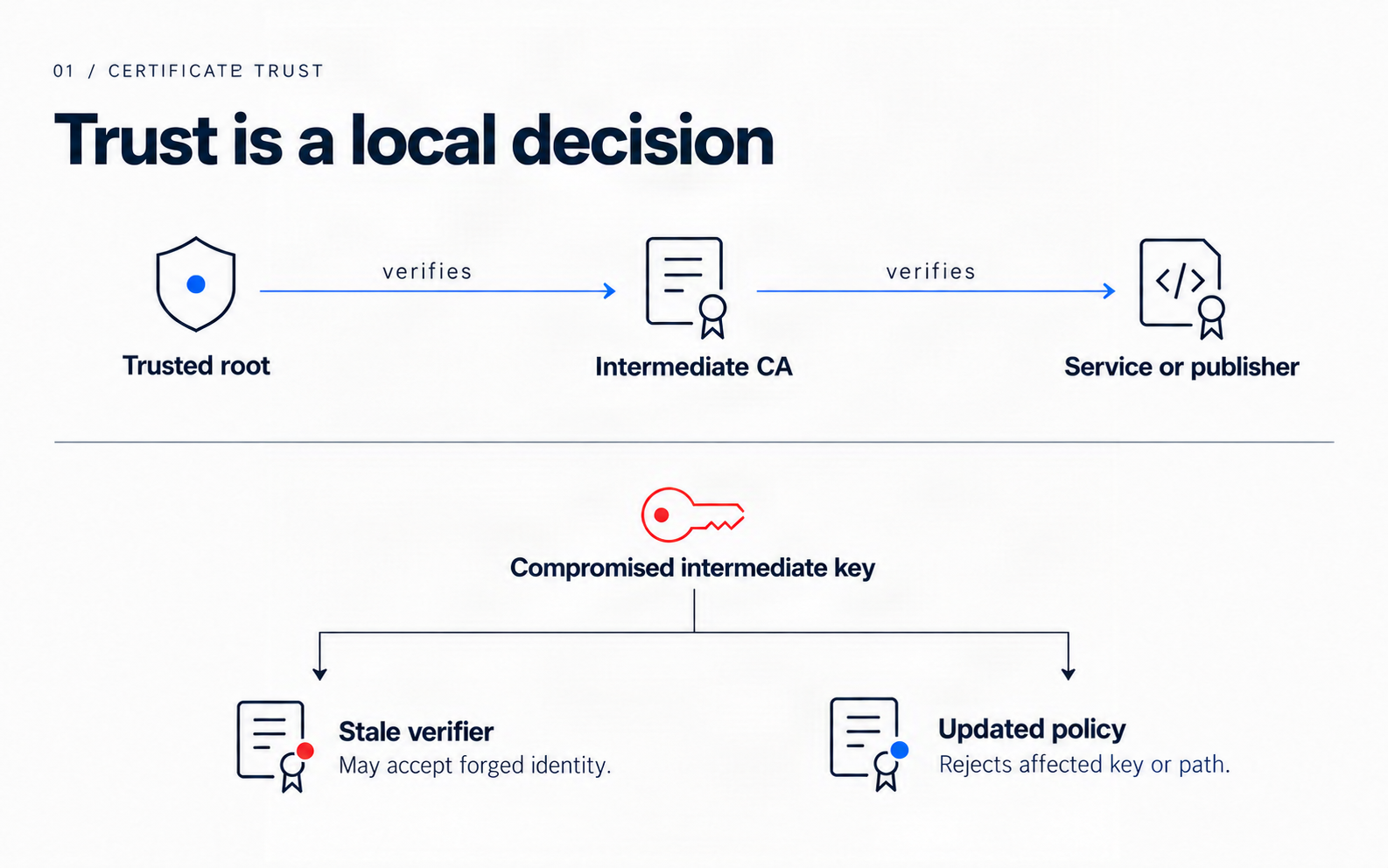
The decision happens in the user’s software. A false identity can pass if its chain and other required checks are accepted. Certificate validation2 also applies purposes, constraints and local policy.
That creates potentially system-wide exposure, not proof that every service was hacked. The reach depends on certificate restrictions, the software’s checks and whether protection has arrived. Browsers’ Certificate Transparency checks helped in this incident. An absence from those logs cannot establish non-use against software that does not require logging. TLS impersonation also requires the attacker to intercept or redirect a connection. Shared trust spreads the risk; enforced checks and timely distrust limit it.
What failed at eMudhra
After a report from a community member identified as Wayne, Mozilla independently recovered eight intermediate CA private keys3. Six were for TLS, which protects network connections, and two were for code signing. Each key had two certificate representations, including a cross-sign from Sectigo. Those alternate certificates gave the same keys additional possible paths to trust. The paths differed by client: Chrome and Mozilla had already withdrawn website trust in Sectigo’s AAA root; other software required its own protection.
The keys were weak from their April 30, 2025 creation3. Each private secret was a number from 1 to 255. Outsiders could recover the signing authority by testing that tiny range. October 17 was the reporting and emergency-response date, not a proven first attack date. This was a key-generation failure recoverable with ordinary computing, not a quantum attack.
In its statement dated October 214, eMudhra says a wrap/unwrap step produced a second, weak set of keys. It says certified hardware security modules were used and that the exact root cause remains unconfirmed. The company reports no infrastructure compromise or data breach. That is its account of the incident; it does not undo the independently demonstrated loss of issuing-key secrecy. Root private-key compromise has not been established. The reviewed primary record identifies no confirmed malicious interception or particular package altered through these keys.
Two different problems for users
For TLS, an attacker could create a false certificate for a familiar website, using a server key the attacker controls. If the attacker can intercept or redirect the connection, and the user’s software accepts the certificate, the user may communicate with the impostor. The real website’s private key need not be stolen. Mozilla describes these conditions5.
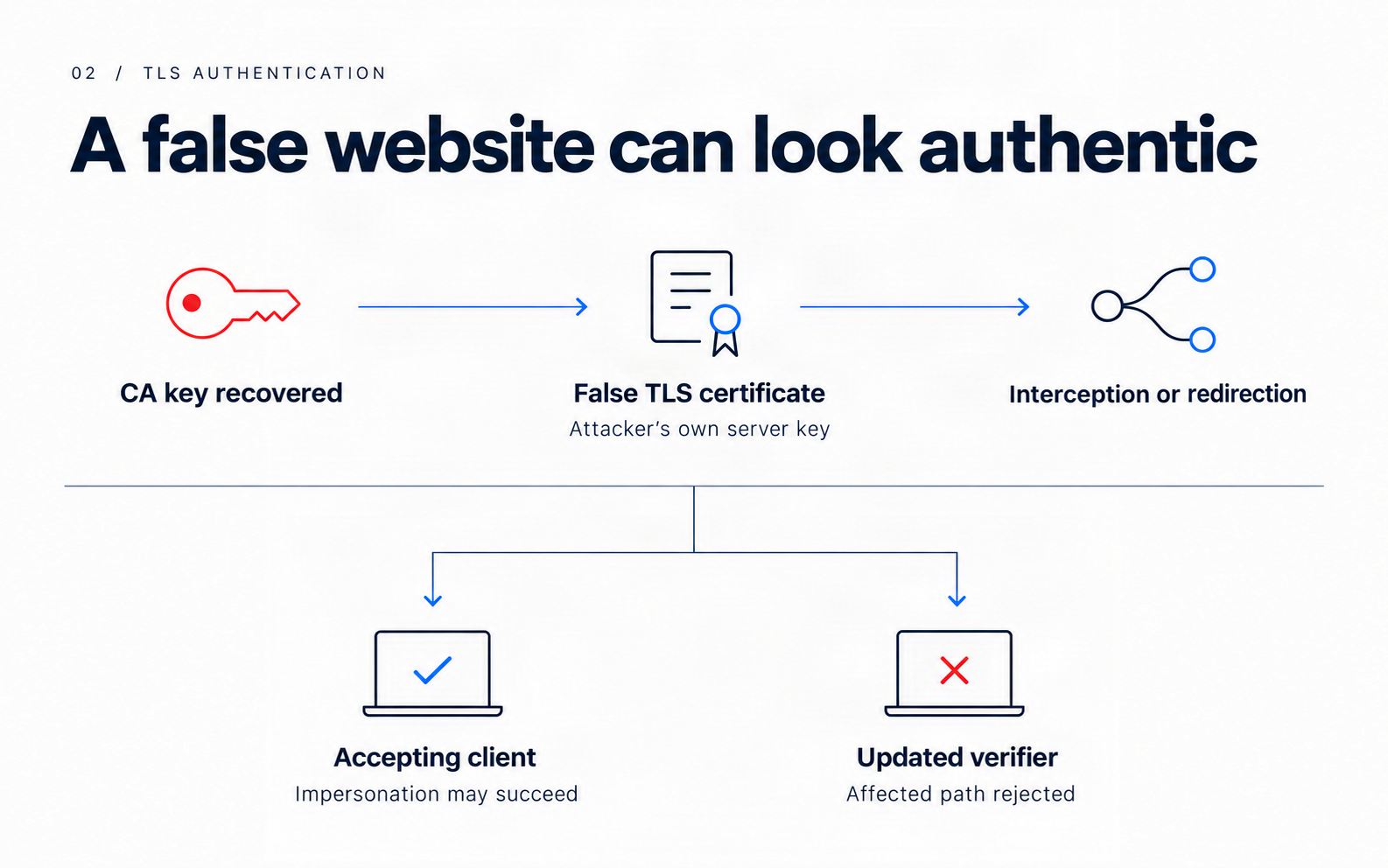
A forged certificate does not redirect traffic by itself. Effective updated rules reject the affected trust path.
For code signing, an attacker could create a false publisher certificate, then sign a malicious file with the attacker’s own key. Software still accepting that authority might treat the file as coming from a trusted publisher. This delivery does not inherently require network interception or theft of the real publisher’s key.
eMudhra says the code-signing issuers were never used in production and issued no end-entity certificates3. That account does not prevent someone who recovers their keys from creating fraudulent certificates independently.
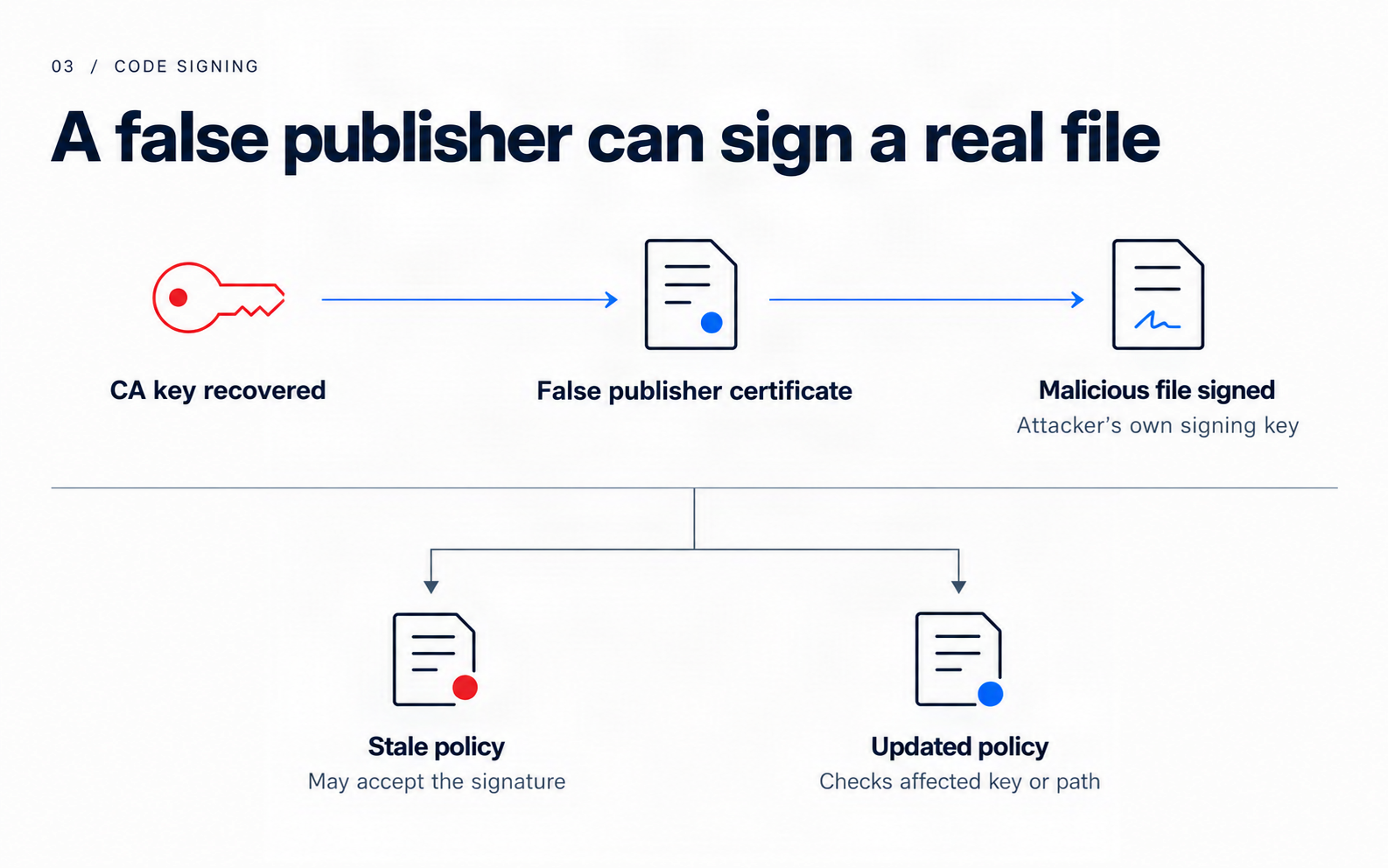
A familiar publisher name is insufficient. A valid signature also does not prove software is harmless. Code-signing verification6 is separate from the browser’s TLS protection.
An authentic file already released does not change retroactively. Whether an older signature remains accepted depends on the platform’s revocation, timestamp and distrust rules. A timestamp is not a universal exemption.
What changes when trust is withdrawn
Revocation tells software that a certificate should no longer be accepted. Blocking a key or removing trust in a root can close additional paths. These controls protect users only when the application doing the check receives and applies them. Publishing a revocation list does not automatically remove a root from every installed trust store.
Chrome and standard Firefox configurations received emergency protection on October 17. Firefox Android 158.0.2 subsequently fixed some profiles that missed the updated blocklist at startup, Mozilla reported on October 213. That did not update every other application on the same computers. A browser, an update agent and a build tool may use different trust data. The root programs explain their responses and limits7.
Google also reports a Google Play services update around October 19 at 22:00 UTC, received by most Android devices; restarting can trigger delivery14. That is not an assurance for every Android device or application.
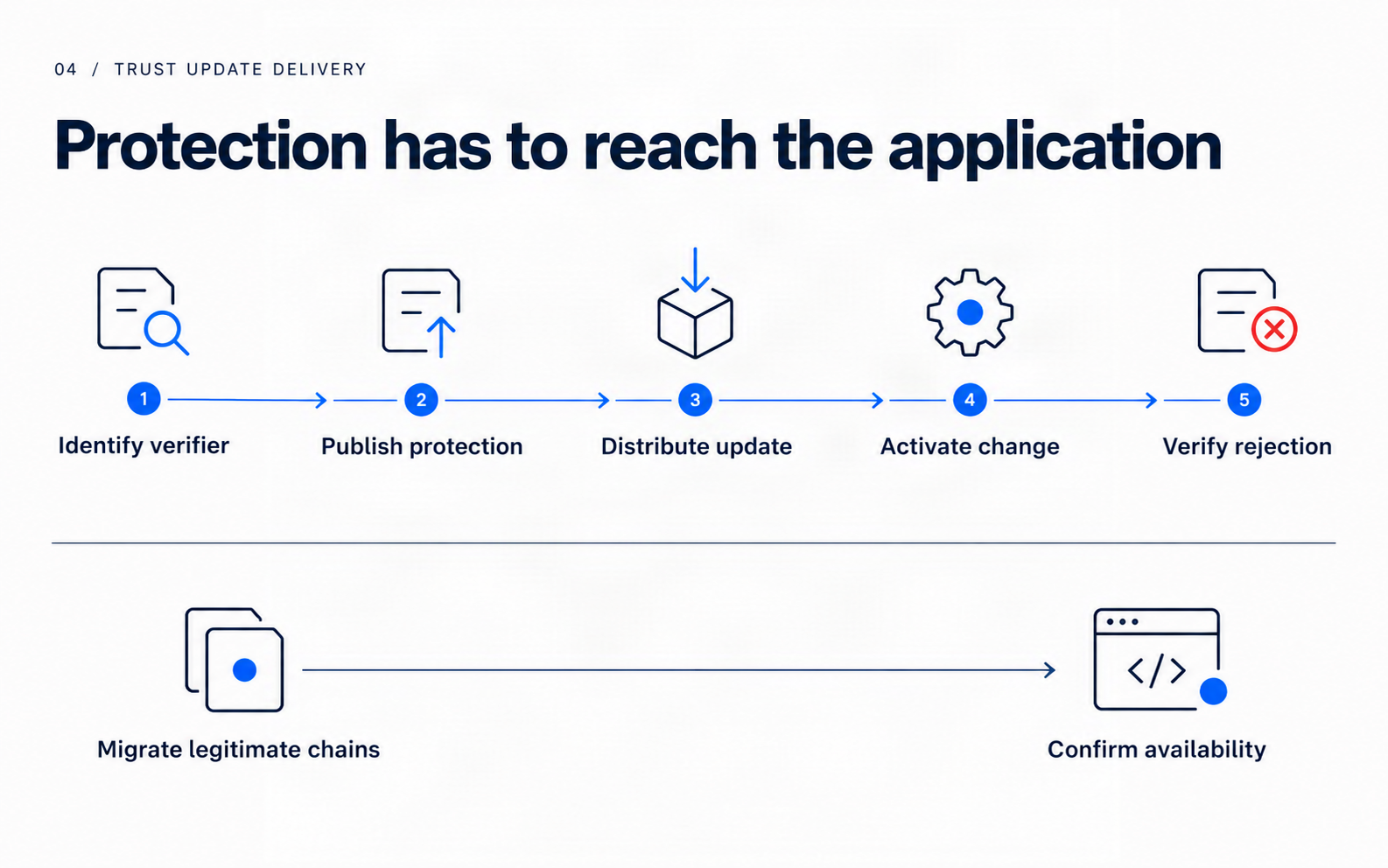
A released fix must reach the software actually making the decision. Updating the browser alone does not establish protection elsewhere.
Distrust can also interrupt legitimate services. Broader withdrawal of the emSign ECC G3 root requires subscribers under other intermediates whose keys were not shown weak to replace their certificate chains. eMudhra’s initial estimate was about 30,000 certificates3, not 30,000 fraudulent certificates. About 97% had originally been obtained through ACME automation. That is an issuance statistic, not proof of successful migration. It reported stopping issuance under that root; its October 21 statement did not establish completed migration.
The company now describes the legitimate-certificate migration as one U.S. customer ecosystem and says replacements are being issued from an alternate, independently operated, publicly trusted CA hierarchy. It does not name that hierarchy or provide a completion count or deadline. That customer description does not bound the risk to unrelated users whose software could accept forged certificates.
Google expects the broader removal of emSign ECC Root CA - G3 to reach Stable Chrome Root Store on Tuesday morning, October 27, 2026, Pacific Daylight Time14. This is separate from the six-key emergency block deployed on October 17. To avoid legitimate connection failures, operators whose service certificates chain to that root should obtain and install replacements from another hierarchy included in the Chrome Root Store.
On October 21, the Chrome Root Program asked eMudhra for affected-CA identifiers, migration instructions, issuer-level completion figures and the name of its replacement hierarchy3. Those questions remained unanswered in the public record reviewed for this article.
Users may see a connection error or a rejected installer. The answer is to update the application or replace the affected legitimate chain. Keep its security checks enabled.
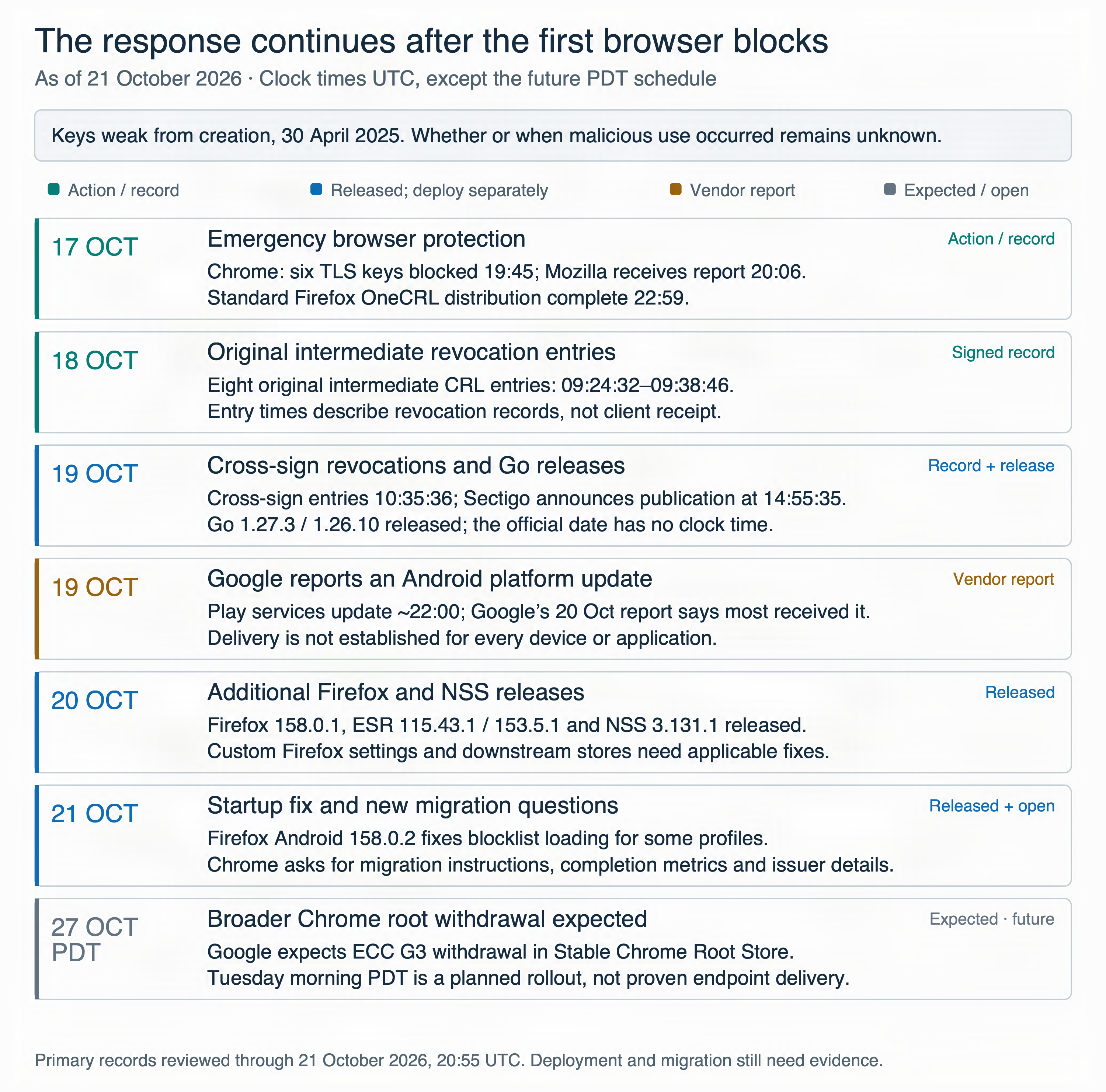
Response timeline through October 21, 2026. CRL-entry times, reported publication, releases and installed-client protection are separate milestones. Google’s October 27 PDT root withdrawal is expected future action, distinct from October 17’s key block. Android delivery is vendor-reported; migration questions remain open. Releases and revocations do not establish endpoint protection or completed migration.3, 5, 14, 15
What to do
Consumers: Install supported browser, operating-system and application updates. Do not bypass certificate or signature warnings. If a service or installer fails, obtain a supported fix from its provider. The date of a download alone cannot tell you whether it was altered.
Enterprises: Identify the applications making network and software-signature checks, their owners and their trust sources. Deploy the relevant fixes into running systems, including containers, custom stores and offline devices. Rebuild applications where required. Confirm that affected paths fail and legitimate replacement chains work. A timeout is not proof of rejection.
For important downloads, compare the bytes with independently trusted release information: authenticated package metadata, a trusted publisher key or a trusted pinned hash. A checksum fetched beside a replaceable file through the same compromised channel is not independent evidence. Preserve suspicious artifacts and relevant logs without running the files. Investigate actual exposure and indicators rather than declaring every post-October 17 download unsafe.
Oracle’s October 21 advisory8 adds interim Java protections while its update is being prepared. Apply the guidance to every relevant runtime and test the applications using it.
What this tells us about the quantum threat
Digital trust reaches far beyond a browser. The seven-layer pyramid connects the mathematics at the foundation to the activities people depend on: using services, proving identity, installing software and protecting information. These functions overlap; the picture is a way to see their trust dependencies.
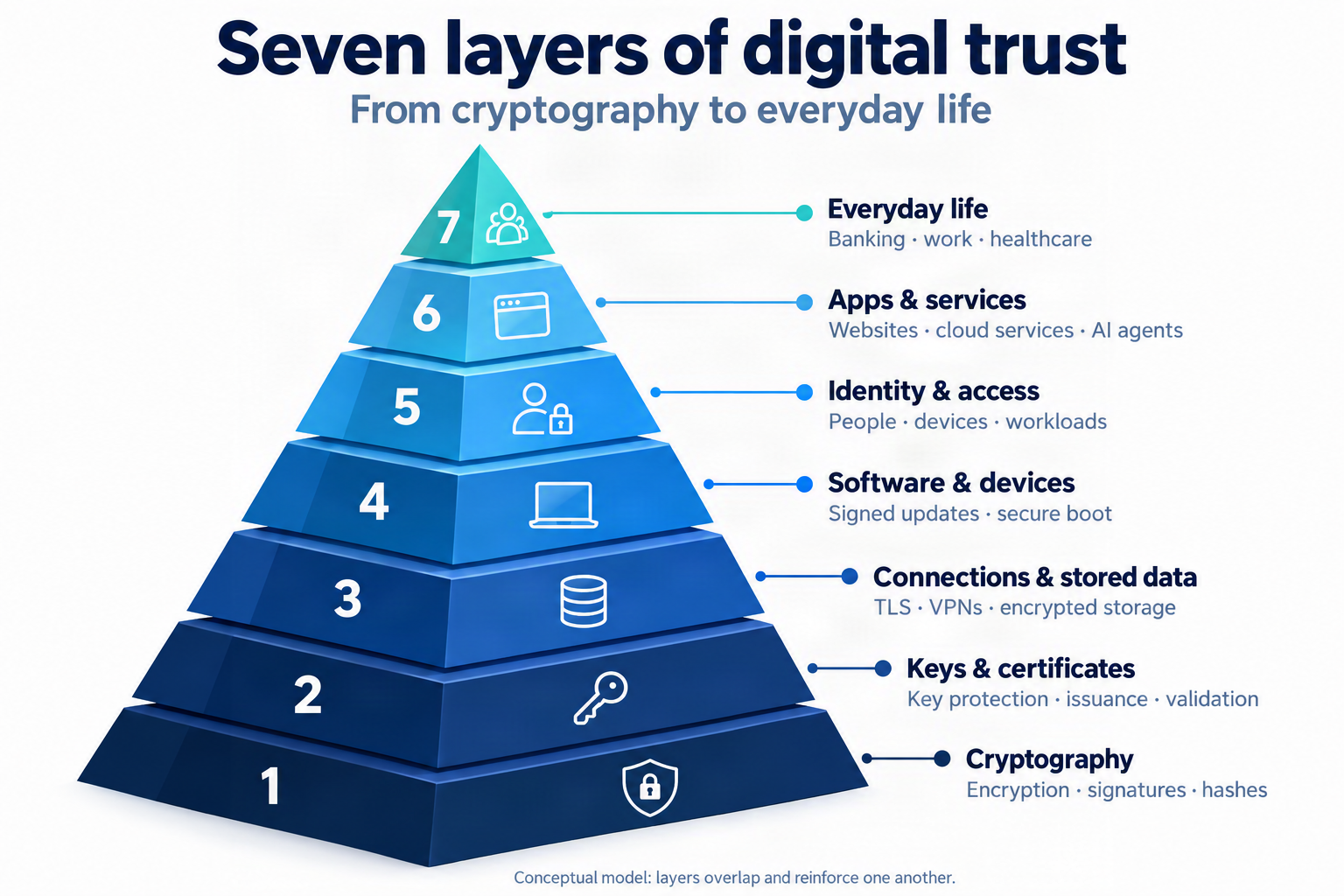
AI-generated conceptual model: cryptography supports trust decisions across connected functions. The layers overlap and reinforce one another.
The resemblance to a future quantum attack is the loss of signing authority. Here, defective key generation made private secrets recoverable. A future sufficiently capable quantum computer could derive private signing capability from properly generated RSA or elliptic-curve public keys. It would not need to open an encrypted private-key file. Software still accepting those keys could accept forged website or publisher identities. NIST describes that prospective mathematical threat9; it does not establish that such a computer exists today.
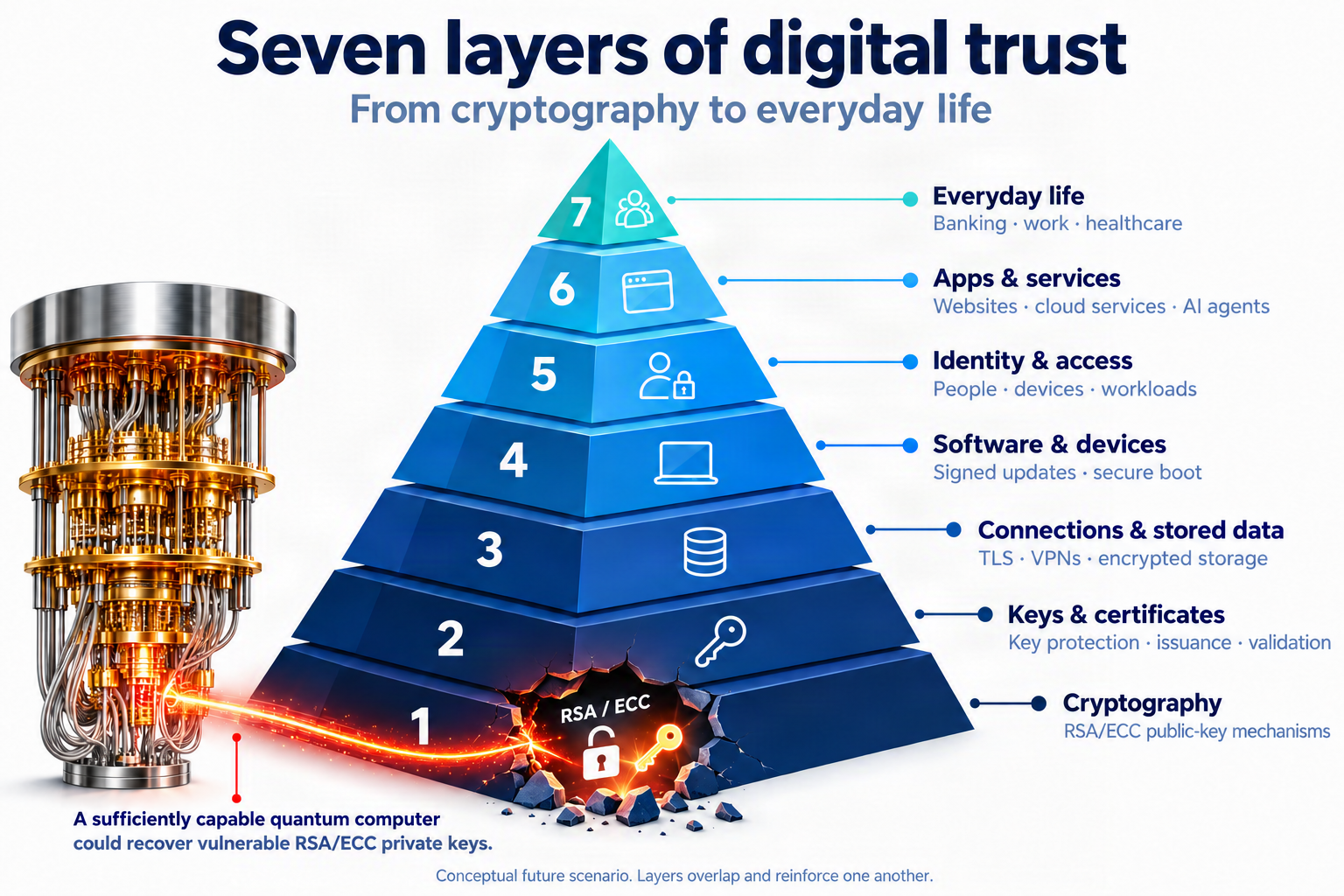
AI-generated future scenario: a sufficiently capable quantum computer could recover vulnerable RSA/ECC private keys. The beam and fracture illustrate mathematical compromise; they are not a physical attack mechanism or evidence about eMudhra.
Controls that depend on a broken signing mechanism lose a crucial assumption. That can spread failure across unrelated services. It does not mean every layer stops working or every cryptographic algorithm has been broken. The eMudhra incident did not break correctly generated P-384 and was not a quantum attack.
Once an attacker knows a private key, no revocation can make it secret again. Authentic revocation or distrust instructions can still tell updated software to reject it. They cannot take back information already exposed. If quantum computing breaks an algorithm’s underlying mathematics, issuing another key using that same vulnerable algorithm will not repair it. That is a different problem from this incident’s defective key generation. NIST’s transition guidance10 retains revocation as a tool for ending acceptance; it cannot restore a lost secret.
Confidentiality needs its own work. An attacker could save encrypted traffic now and later attack vulnerable key agreement. Recovering a CA signing key alone does not decrypt recorded forward-secret TLS sessions. Post-quantum migration must address both key agreement and digital signatures.
NCSC’s technical guidance11 recommends supported post-quantum TLS key agreement now and says authentication standards for TLS and the wider Web PKI are still developing. Its October 15 blog12 says authentication recommendations are planned in the coming months. One deployment does not finish both jobs.
That leaves two jobs:
- Deploy supported post-quantum cryptography. Prioritize long-lived information, signing and verification dependencies, and devices that will be hard to replace. Use protections that the relevant protocols and products support.
- Build mature crypto-agility across the whole dependency chain. Your applications, devices, suppliers, customers and other parties that rely on your credentials need compatible changes. Inventory those dependencies, assign owners, test replacements and rehearse withdrawing old trust. Prove that systems use the new protection and reject retired options.
Post-quantum cryptography will also need continuing scrutiny. NIST plans for possible algorithm weaknesses13; implementations can have defects too. The response may be a software fix, revised parameters or protocols, or a replacement algorithm. Crypto-agility is the tested ability to make the needed change safely across interdependent systems. It is an ongoing capability, not a one-time cipher upgrade.
Keep sound key-generation and update controls. Replacing this incident’s certificates can contain its particular failure. Preparing for quantum threats also means changing the cryptography and making the next transition possible.
About the author
Tim McAllister is Regional Field CTO at DigiCert, leading customer-facing technical strategy for device trust, PKI and post-quantum cryptography. He writes about digital trust and the practical work of securing connected products at timmcallister.io. The views expressed here are his own.
Sources and notes
CertiNext — Certificate Lifecycle Management. eMudhra’s service description identifies emSign as powered by eMudhra. Living product page; consulted for the company/service relationship.
IETF, RFC 5280: Internet X.509 Public Key Infrastructure Certificate and Certificate Revocation List (CRL) Profile, May 2008, §6.1. Certificate-path validation and trust-anchor inputs.
Mozilla, Bug 2083449: eMudhra: Private key compromise of Intermediate Certificates, public record and dated comments, October 18–21, 2026. Relevant entries: initial report and key inventory, independent key analysis, CA issuance account, Firefox Android update, initial migration estimate, Chrome Root Program migration questions. The record contains independently verified findings and separately attributed CA/cross-signer statements.
eMudhra, eMudhra Statement on Recent Certificate Security Incident, Update 3, October 21, 2026. The company’s account of the procedure, claimed impact and replacement work; the exact operational cause remains under investigation. Its summary dates differ from the contemporaneous incident record in note 3.
Mozilla Security Blog, Protecting Firefox users following the compromise of eMudhra intermediate certificates, October 20, 2026, updated October 21. Firefox/OneCRL response and the Android startup fix; not an all-application protection attestation.
NIST, Security Considerations for Code Signing, January 26, 2018. Distinguishes certification, file signing and verification.
Mozilla dev-security-policy, Compromised eMudhra Intermediate Certificates, especially the Chrome Root Program’s October 20 statement. Documents the response, Certificate Transparency findings and downstream limits.
Oracle eMudhra advisory, last updated October 21, 2026. Incident-specific interim Java guidance while an update is prepared; apply the relevant vendor/runtime instructions and verify application uptake.
Yi-Kai Liu and Dustin Moody, Post-quantum cryptography and the quantum future of cybersecurity, Physical Review Applied 21, 040501, April 9, 2024. A research paper on the prospective quantum threat, not a NIST cryptographic standard.
NIST CSWP 39upd1, Considerations for Achieving Crypto Agility: Strategies and Practices, December 19, 2025, updated June 29, 2026. Crypto-agility and the processes for ending acceptance of retired or compromised mechanisms.
UK National Cyber Security Centre, Using TLS to protect data, version 1.2, October 15, 2026. Technical deployment guidance; post-quantum key agreement and authentication have different readiness.
UK National Cyber Security Centre, Post-quantum updates to our TLS guidance, October 15, 2026. Explains the guidance change and planned authentication recommendations.
NIST, What Is Post-Quantum Cryptography?, created August 13, 2024, updated February 27, 2026. PQC selection, continuing evaluation and possible weaknesses.
Chrome and Android Security Teams, Protecting Chrome and Android Users from Compromised eMudhra Intermediate CA Certificates, October 20, 2026. Google’s delivery report and expected broader Chrome Root Store removal schedule; neither guarantees every endpoint or application is protected. The Stable timing is also identified in the October 21 Chrome Root Program comment linked in note 3.
Go project, Release History, entries for Go 1.27.3 and 1.26.10 dated October 19, 2026; Mozilla, NSS 3.131.1 release notes. These are published-release records, not evidence of deployed protection.
Illustration and logo attributions
The incident was reported by community researcher Wayne; Mozilla independently recovered the weak keys. Their contributions are recorded in Bugzilla’s initial report and analysis. Sectigo’s cross-signing role and subsequent revocation updates are documented in comment 6 and comment 13.
Seven of the illustrations, including the digital-trust pyramids, are AI-generated conceptual images prepared for this article under Tim McAllister’s direction. The response timeline was authored from primary-source data with AI assistance. These illustrations are explanatory models, not forensic reconstructions. eMudhra and emSign marks identify the article’s subject and do not imply endorsement. Official brand references: eMudhra and emSign.