
I write regularly about the EU Cyber Resilience Act for more than 16,000 followers on LinkedIn. In one of those posts, I included AI-generated statements about how the Act’s rules apply to OEMs. They read well. They also got the rules wrong, and I hadn’t checked them against the text of the regulation. A very knowledgeable reader caught it. I corrected the post and reposted it. I was grateful for the catch, and the lesson stuck. The polished prose had made an unverified claim feel settled, and I was the first one it fooled. With an audience that size, a confident mistake travels fast.
Then there was a piece where the facts held up. I shared it with a few peers. By most measures it was great writing. It was clean and well structured, and the thesis was supported. Their feedback was polite and blunt: what’s the point here? They didn’t think it was wrong. They didn’t think it mattered. One of them said I needed to put my brain first, ahead of what the AI could produce.
That stung. They were right.
Those were two different failures with the same cause. In both cases I let the AI’s craft stand in for my own thinking.
AI can turn a rough idea into a well-crafted essay before the person who supplied the idea has worked out whether it’s true, or whether it’s worth saying. That’s useful. It’s also a problem.
The awkward sentence used to warn us. We’d stop, try again, and sometimes find we couldn’t explain the thought because we hadn’t understood it yet. Now the sentence arrives fully formed, and the uncertainty underneath it can go unnoticed.
What’s getting cheap is the craft that used to signal great writing: strong structure, clean rhythm, evidence in the right place. When anyone can have all of that on demand, the craft stops telling the reader much. What’s left to judge is the point, and whether it’s true.
What should happen in the reader?
There’s no single right way to write something well. There are better and worse ways to accomplish a particular purpose.
Take a problem I run into often: explaining public-key cryptography to a business executive. Be too rigorous and they leave unable to make the decision in front of them. Simplify too much and you hide the one distinction they needed. The writing has to find its way between those two failures. Accuracy matters, and so does whether the reader can use what you gave them.
Nonfiction can help someone understand, reconsider, remember or act. It can make another person’s experience available to us. A good essay can leave us with a better question than the one we brought to it.
So here’s the distinction I’d draw. Well-crafted writing uses language and structure skillfully. Great writing does that to produce a change in the reader that’s worth their time.
“Worth their time” is doing real work in that sentence. Aristotle saw the problem more than two thousand years ago. In the Rhetoric he admits that the power of speech can do great harm when it’s used unjustly. A persuasive lie can still achieve its author’s goal. Skill alone can’t tell us whether the work deserves trust.
Still, starting with the reader gives us something concrete to test. What should this person understand by the end? What do they need to meet along the way?
We’ve been working on this for a long time

People have been experimenting with language for thousands of years. Arguments, letters, speeches, criticism, reporting and technical explanation have each developed reliable ways to hold attention and make meaning. There’s no universal formula, but there’s an enormous body of practice to learn from.
Consider the range. In The Fire Next Time, James Baldwin brings his own experience into an argument about race and American life, and makes it personal without making it small. Rachel Carson’s Silent Spring connects scientific explanation to public consequence. In The White Album, Joan Didion chooses and arranges what she saw in the late 1960s, and that choosing and arranging asks the reader to make sense of it with her.
None of these books is great only because of its sentences. Each one shows how material can be shaped to change what another person sees.
Models trained on large amounts of text learn patterns from that practice: familiar ways to introduce context, build an argument, or explain something unfamiliar. They also learn from plenty of bad reasoning and empty language, and patterns alone don’t give a model an author’s experience or judgment. But AI doesn’t have to rediscover the mechanics of great writing from scratch. That’s why it can help even with subjects it has no firsthand knowledge of.
McPhee’s lesson: arrangement is thinking
John McPhee’s Levels of the Game is built around a 1968 tennis match between Arthur Ashe and Clark Graebner. The match gives the book forward motion. The players’ lives give it depth. The structure makes you care about the next point while you learn more about the people playing it. The movement between action and background is part of what the book means.
In his essay “Structure,” McPhee describes the struggle to find an organizing principle for a mountain of reporting. Having the material and knowing how to arrange it are separate problems. In “Draft No. 4,” he puts revision at the center of the work. The first draft exists to give him something to reconsider, and later passes refine it down to individual words.
This matters more when AI is in the loop. A polished draft that arrives in seconds gives you more time to question it. It doesn’t mean the hard decisions have been made. A model can reorganize a draft instantly, and the new version may read more smoothly while quietly changing the argument, dropping a necessary complication, or revealing something too soon.
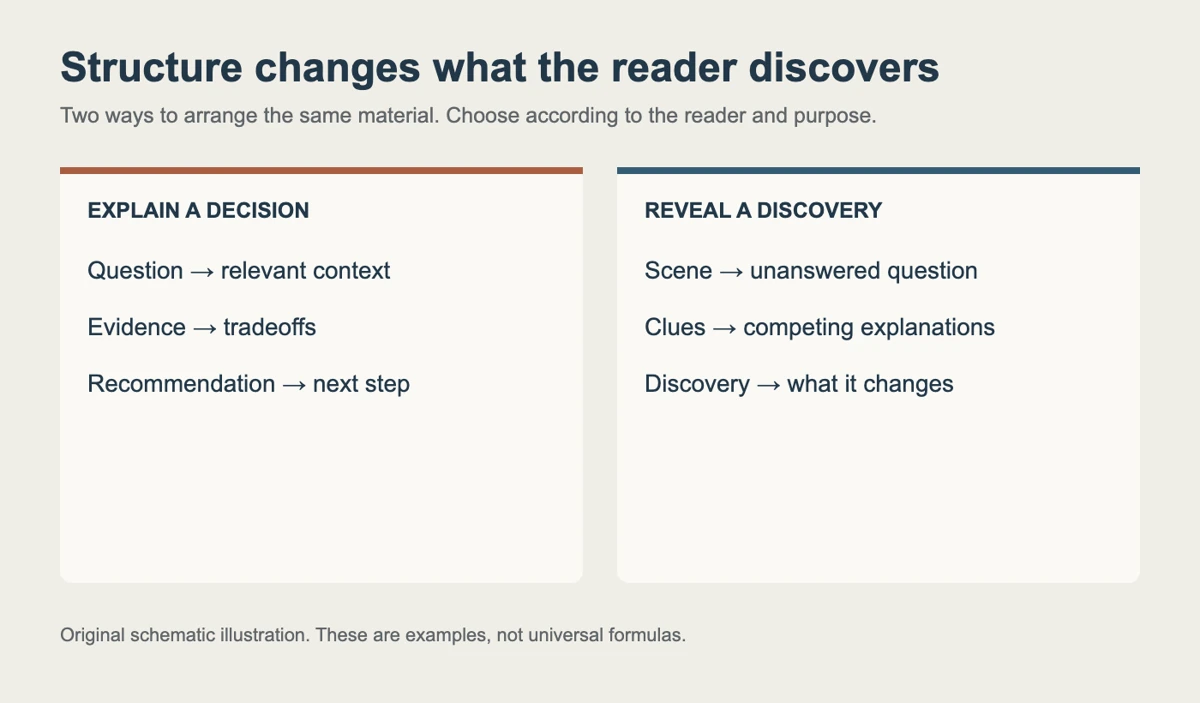
Every rearrangement deserves scrutiny. Why does this example come first? What does the reader know when they reach this claim? Is the conclusion earned by the evidence before it? Those questions are the thinking. Polishing the language afterward can’t answer them.
The software parallel
In software, AI can turn a description into working code, explain it, and suggest changes. In Anthropic’s first Economic Index, published in February 2025, Claude usage was concentrated in software development and technical writing.
But generated code leaves the hard questions open. Does it solve the actual problem? Who can access the data? What happens when a dependency fails? How do we know it works beyond the demo? A system can look functional while faithfully implementing a bad requirement.
An essay can do the same thing. It can move cleanly from opening to conclusion while resting on a wrong fact. That’s what happened with my CRA post. The argument flowed. The explanation of how the rules apply to OEMs was wrong.
In both code and prose, the person directing the work needs to understand it well enough to judge what came back. Clear instructions help, but the instructions themselves can contain the mistake.
AI can help find that mistake too. Ask it to challenge your premise, point out missing evidence, or argue a competing explanation. Then check its answers as well. The value comes from putting the idea under pressure. With regulation, that means going back to the primary text every time. I do now.
What does Pangram actually test?
AI detectors answer a different question. Pangram describes its system as a classifier that labels text as human-written, AI-assisted or AI-generated. That’s a prediction about how the writing was produced. It says nothing about whether the writing is great, or even good. A human can write a confused explanation. An AI-assisted one can be accurate and useful.
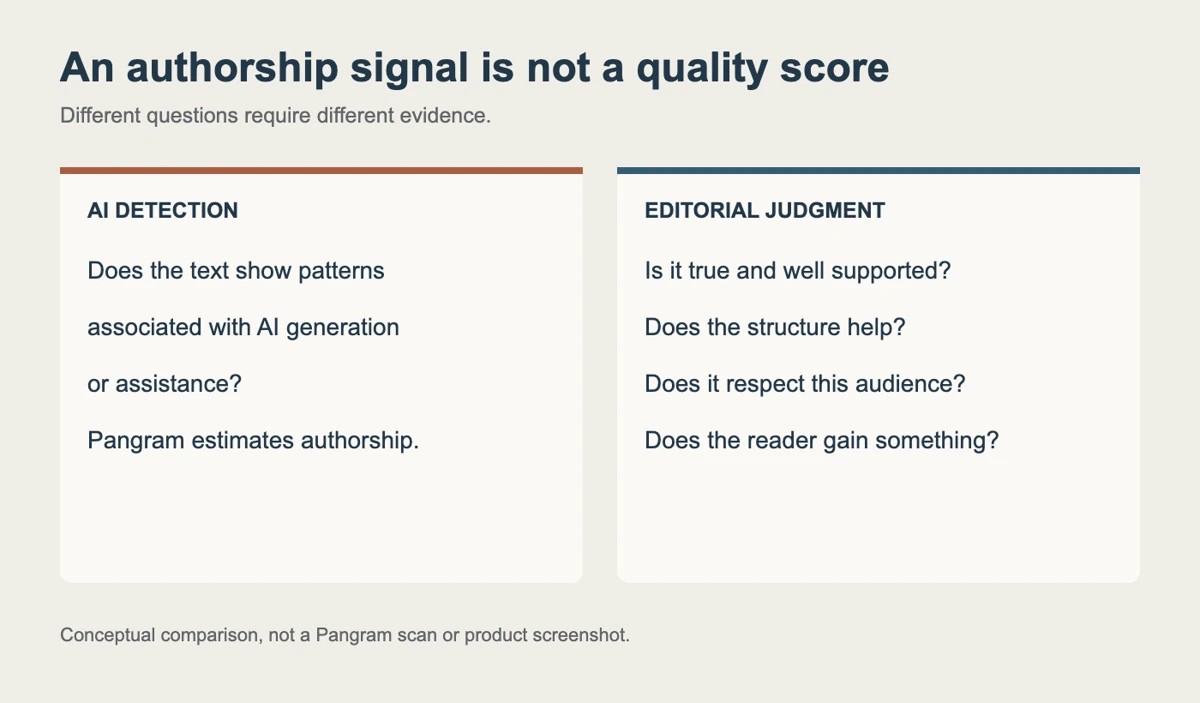
If a publisher cares about provenance, a detector can be one signal worth looking into, alongside drafts and an honest account of the process. If the question is quality, you have to examine the claims, the evidence, the structure, and the effect on the reader.
Editing toward a “human” label sends you the wrong way. Adding quirks to satisfy a detector doesn’t give an essay better ideas. I’d rather revise because the argument can’t survive an objection, or because a reader can’t follow it. Those failures tell me something worth fixing.
Keep the discovery in the process
We often find out what we think by trying to write it. A stubborn paragraph exposes a contradiction. An example that won’t fit shows that the thesis is too broad. When AI hands you a polished draft right away, you skip that struggle, and you need to put it back on purpose.
AI lowers the barrier to great-looking writing. More people can get ideas out of rough notes and in front of readers, and that’s a real gain. It also makes it easier to publish before you’ve finished thinking.
Brain first
When everyone’s writing looks great, polish stops earning trust. Readers fall back on two questions: were you right, and was it worth their time?
The reader who caught my CRA mistake told me. Most readers won’t. They’ll quietly decide you’re not worth reading, and you’ll never know which post did it.
So I now run three questions on every draft before it goes out. I learned each one the hard way:
- What’s my point? Write it in one sentence, yourself, before any AI touches it. If you can’t, you aren’t ready to write. My peers saw that before I did.
- What would the most knowledgeable reader challenge? Find that claim and check it against the primary source: the regulation, the standard, the data. Not the AI’s summary of it. That step would have saved my CRA post.
- Strip out the polish. Is the point still worth reading? If the craft is the only thing it has going for it, it’s not done.
Run them on the draft you have open right now. It takes a few minutes. The readers you lose won’t send a correction. They’ll just stop reading.
Your name is on the work. Put your brain there first.
Which of the three questions would your last post have failed? Tell me, or subscribe for more on AI, security and the craft of explaining hard things.
How this essay was made: I drafted it with AI assistance, checked the cited sources against the originals, and revised it over several passes. The argument, the mistakes described above, and the final call on every sentence are mine.