A 45-minute assessment revealed something counterintuitive about AI fluency.

Anyone here come across AI Cred (aicred.ai)?
Holiday break confession: I spent the downtime nerding out on AI projects. I vibe-coded a fitness accountability app (overload.army — still in alpha), and somewhere along the way took an AI fluency assessment called AI Cred.
Plot twist: I’m currently #1 on their leaderboard with a 9.9/10 score.
Here’s what makes that strange — I’m not a coder. I’m a cybersecurity executive. My daily AI use is almost entirely business-oriented: generating deep technical reviews of regulations like the EU Cyber Resilience Act and FDA Section 524B, building market impact assessments, and creating adoption frameworks for global enterprises. The “code” I write is really just AI-assisted problem-solving with a business lens.
So why would someone like me top a leaderboard that includes engineers and developers?
What the Assessment Actually Measures
AI Cred evaluates fluency across five dimensions, each scored separately:
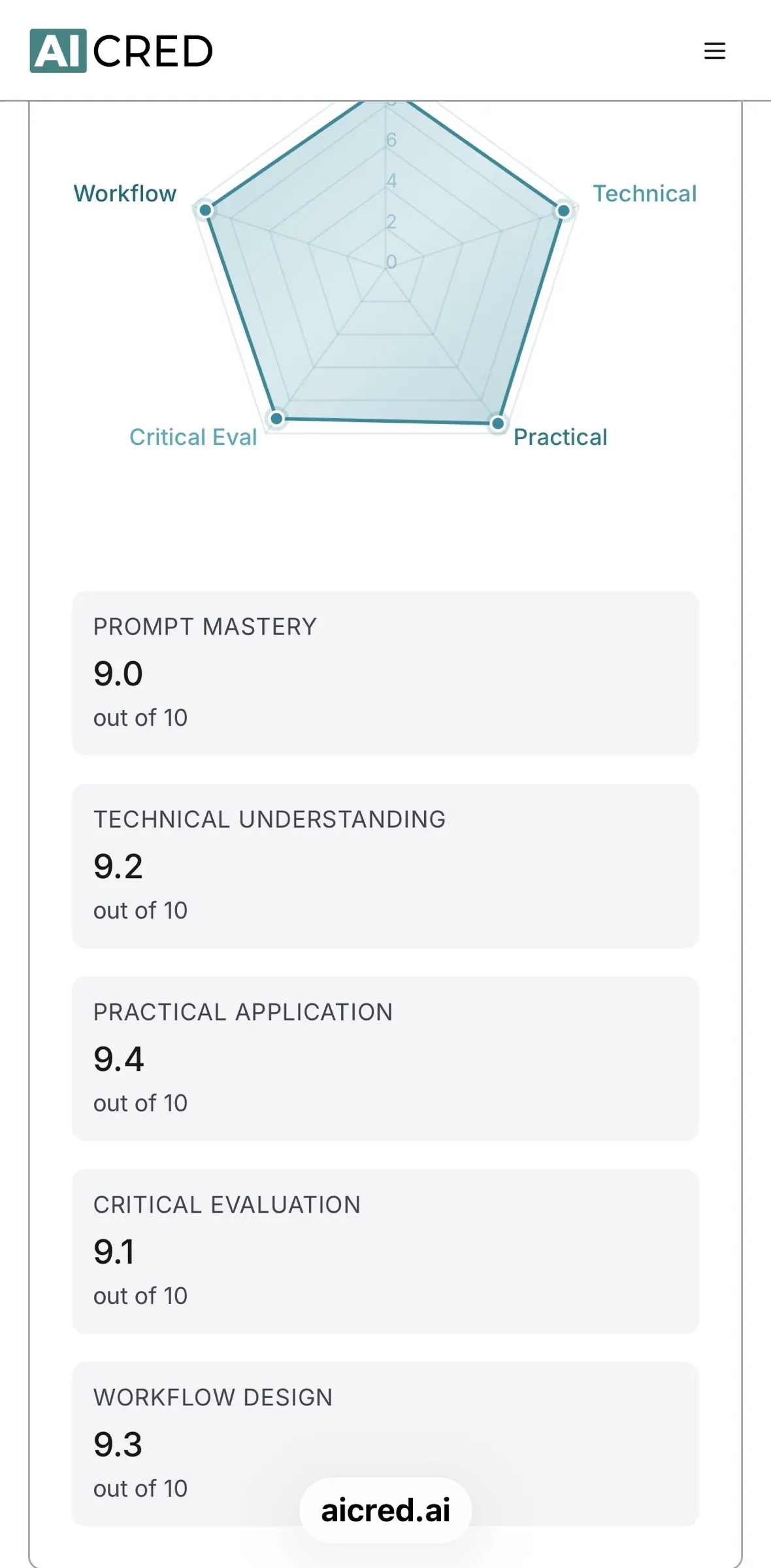
The results include a radar chart showing your shape across all five dimensions — useful for spotting gaps. They also assign a “Velocity” rating (mine was “HIGH”) which appears to measure learning momentum or engagement depth.
Logistics:
∙ Time: ~45 minutes
∙ Cost: $20
∙ Assessment date tracked: Mine shows 12/20/2025
Who built it:
∙ Jonathan Edwards (Limited Edition Jonathan on Substack) — creator and platform architect
∙ Nate B. Jones (natebjones.com) — prompt engineering. Nate is a former Head of Product at Amazon Prime Video where he led ML personalization and content delivery for 200M+ viewers. Now an AI strategist with 250K+ TikTok followers and a widely-read Substack on applied AI.
The Counterintuitive Finding
Looking at the leaderboard, I expected young tech natives to dominate. Instead? The top performers are experienced professionals applying AI to domains they already understand deeply:
∙ A multi-decade workforce veteran architecting legislative document analysis
∙ A 40-year Microsoft/Google engineer treating AI agents as a “managed fleet”
∙ A history teacher catching hallucinations before they reach students
∙ Security professionals who assume AI is lying and build verification systems
The leaderboard tagline captures it well: “Doctors, developers, executives, creators — the professionals redefining what’s possible with AI. These are the builders shaping what comes next.”
The assessment summary they generated for me noted “exceptional systematization capabilities — building frameworks that transform complex security architectures into repeatable, teachable processes.”
That tracks. I don’t use AI to write code. I use it to translate technical complexity into business action — regulatory impact assessments, adoption roadmaps, competitive analysis. The skills that make me effective at my job (systematizing complexity, evaluating outputs critically, designing repeatable workflows) turn out to be the same skills that make someone “AI fluent.”
The Takeaway
AI fluency isn’t about knowing how to code or memorizing prompt tricks. It’s about:
1. Knowing your domain deeply — AI amplifies expertise; it doesn’t replace it
2. Evaluating outputs critically — Assuming AI might be wrong and building verification into your process
3. Designing workflows — Making AI use systematic and repeatable, not ad hoc
4. Understanding constraints — Knowing when AI helps and when it doesn’t
The people winning at AI aren’t prompt engineers. They’re professionals who were already great at their jobs and learned to use AI as a force multiplier.

Try It Yourself
Disclosure: I have zero affiliation with AI Cred — just genuinely interested in tools that measure applied AI fluency rather than theoretical knowledge. (My testimonial does appear on their homepage, which happened after I completed the assessment.)
If you’re curious where you stand, the assessment is at aicred.ai. It takes about 45 minutes and costs $20.
I’m curious: Are you using AI primarily as an idea generator, or more as a filter for what not to do? The latter has been the bigger unlock for me.
Tim McAllister is Senior Director of Digital Trust at DigiCert, focused on IoT security, PKI infrastructure, and regulatory compliance. He writes about applied AI in cybersecurity and enterprise technology.