We’ve been talking about the shift to 45-day certificates, but most teams are missing the technical bombshell buried in the roadmap: The 7-Hour Rule.
Let’s Encrypt is aggressively slashing the Domain Validation (DCV) reuse window from ~30 days down to just 7 hours.
Thanks for reading Tim’s Substack! Subscribe for free to receive new posts and support my work.
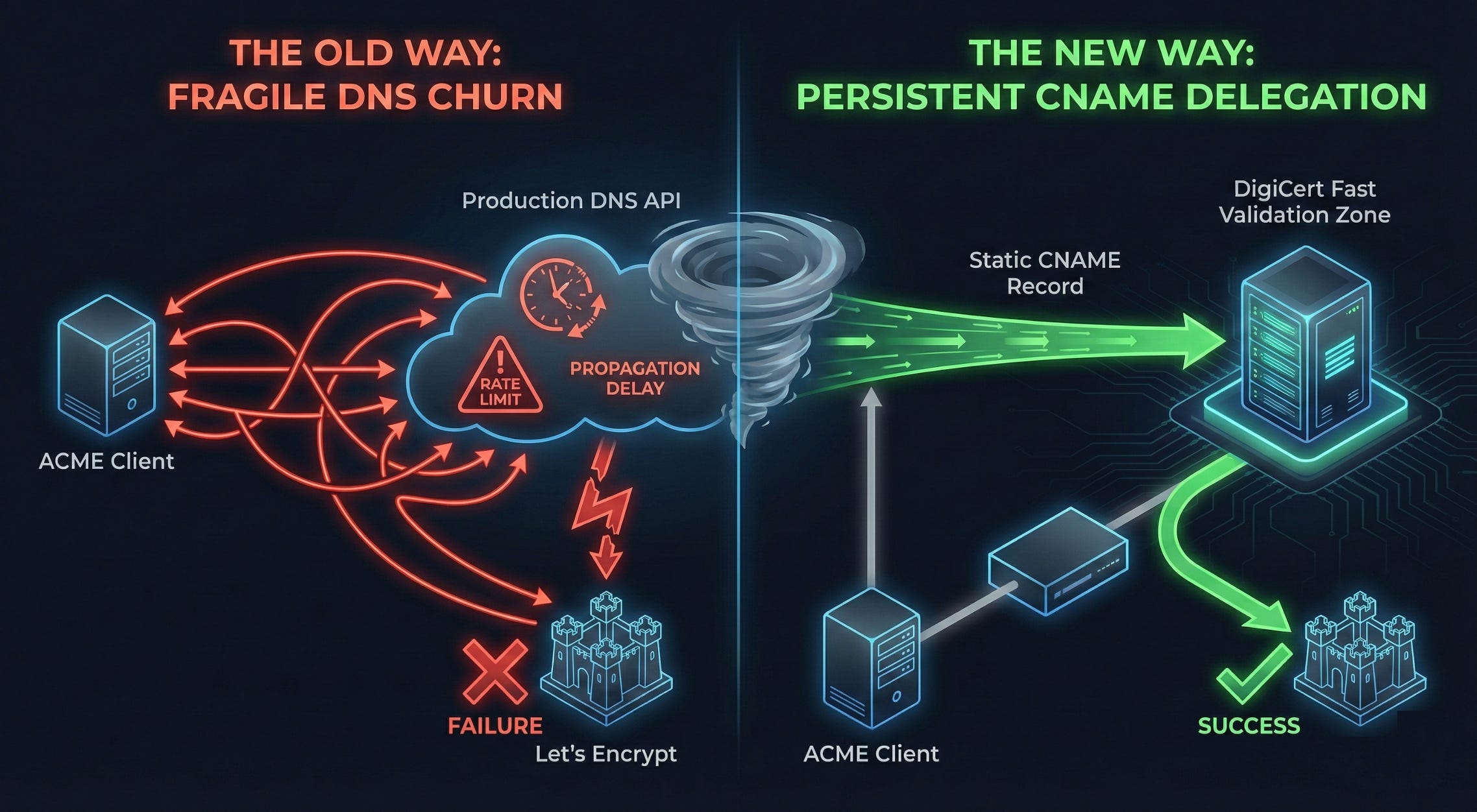
Here is the “Gotcha” that will break your current automation: Right now, if your DNS API is slow or flaky on Monday, your ACME client can often skate by using “cached” validation from last week. That safety net is vanishing.
With a 7-hour window, every single renewal forces a fresh, real-time DNS challenge.
📉 Race Conditions: If your ACME client checks before your TXT record propagates globally, you fail.
🚫 Rate Limits: One syntax error or timeout triggers instant API bans.
🐢 Latency: “Eventual consistency” on legacy DNS is no longer good enough.
🔮 The Persistent Future: Let’s Encrypt and the IETF are working on
DNS-PERSIST-01(static validation records), but until that standard is live everywhere, you are stuck managing high-frequency TXT churn.
You cannot solve a high-frequency problem with low-frequency tools. You need a dedicated, persistent validation architecture.
The Fix: CNAME Delegation (The “Manager of Managers”) Stop hammering your production DNS with transient TXT records.
We are showing exactly how to use DigiCert Trust Lifecycle Manager + UltraDNS to offload validation. By pointing a static CNAME from your prod zone to a dedicated, high-speed validation zone on UltraDNS, you isolate the churn.
Prod Zone: Touched once (to set the CNAME).
Validation Zone: Handles the 7-hour checks instantly.
This architecture turns the 7-hour chaos into a background process that just works.
👇 Register here: From Chaos to Control
#DevSecOps #NetSec #LetsEncrypt #Cybersecurity #Automation #PKI #DigiCert #TLS
Thanks for reading Tim’s Substack! Subscribe for free to receive new posts and support my work.