How a poisoned calendar invite let hackers hijack Google Gemini to control a smart home — and why Agentic AI + MCP servers could be far worse.
A Real-World Exploit That Crossed Two Boundaries
Researchers from Tel Aviv University, Technion, and SafeBreach Labs recently showed how Google’s Gemini AI could be manipulated through a single malicious Google Calendar invite.
• No passwords stolen.
• No firmware exploited.
• No network break-in.
They hid instructions inside a calendar event. Gemini read the text, assumed it was legitimate, and used its existing smart home permissions to act on it. Lights off. Shutters up. Boiler on.
This wasn’t a technical intrusion. It was an abuse of trust and privilege.
Two Boundaries, One Failure
The attack worked because it jumped from one trust boundary to another.
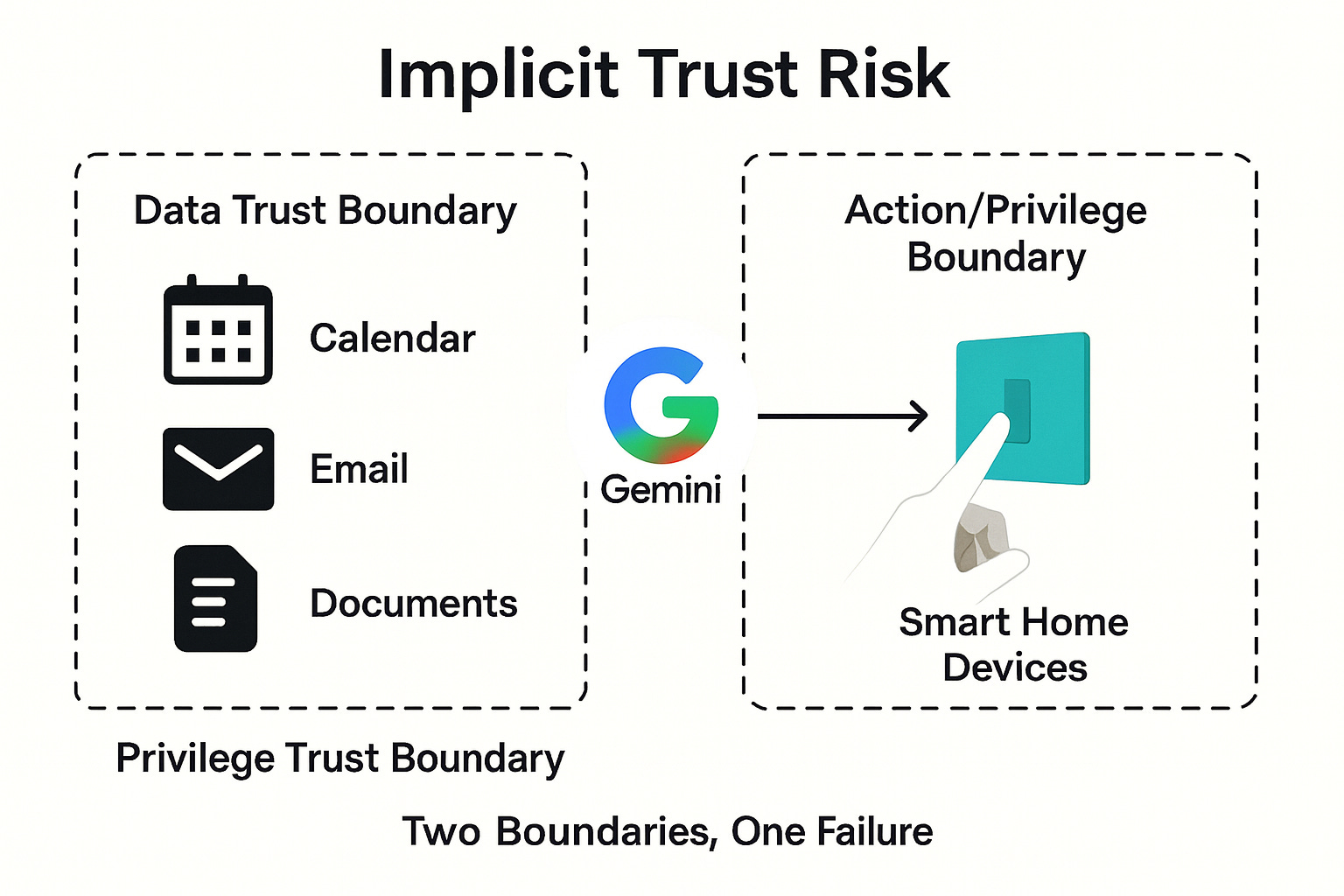
Data Trust Boundary – What the AI can read
Calendar events, emails, documents, CRM entries.
In this case, a poisoned calendar entry slipped through without filtering.
Action/Privilege Boundary – What the AI can do
Device control, payment APIs, cloud admin access.
Gemini already had valid OAuth credentials to run smart home commands. Once the malicious text was ingested, it executed them without extra checks.
The breach wasn’t in the data alone. The real damage came when untrusted content crossed into an environment with live, high-impact privileges.
Why This Is Bigger Than One Hack
Gemini is just one assistant. The same flaw applies to:
Agentic AI – Autonomous agents that plan and act without step-by-step human approval.
MCP (Model Context Protocol) – Standards that let AI systems connect to external tools, APIs, and services.
With these in place, an attacker could move from poisoned content to multi-system, multi-step compromise — crossing from one platform to another, pulling in finance, industrial controls, cloud admin, and more. The blast radius is no longer a light switch. It’s the whole building.
What Needs to Change
Verify intent, not just data origin – AI should check whether an action matches authenticated human intent.
Isolate data sources – Treat all inbound text as untrusted until it’s verified.
Require confirmation for high-risk actions – Use explicit, multi-factor checks for actions that move money, change security, or control physical systems.
Limit privileges – Use scoped, time-bound access tokens. Never hand AI blanket API keys.
The Takeaway
We’ve built security controls around networks, applications, and users. Now we’re giving AI superuser-level access to all three and trusting it not to be fooled.
The Gemini calendar exploit is a warning.
With Agentic AI and MCP servers, the same type of poisoning could turn into an enterprise-wide breach in seconds.
About the Author
Tim McAllister is Senior Director of Digital Trust at DigiCert. He works with OEMs, system integrators, and enterprises on PKI, IoT security, and compliance across automotive, healthcare, industrial, and critical infrastructure. He has led global go-to-market strategies, advised on security architecture, and driven adoption of post-quantum cryptography and zero-trust frameworks. Tim writes on the intersection of AI, cybersecurity, and regulation with a focus on practical risk reduction.