The short version:
The question after the July 29, 2026 2026 Minimum Elements for a Software Bill of Materials update is not whether every software company must sign an SBOM. The joint guidance, Version 2.1, expressly says its minimum elements do not create new requirements.1 The practical question is who will be asked to prove what is in the software, how that record was produced, and whether it belongs to the artifact a customer received. A digital signature is now an explicit SBOM element for proving integrity and authenticity. That will make unsigned, incomplete, or unverifiable SBOMs harder to defend in government procurement, regulated markets, enterprise security reviews, and software supply-chain negotiations.
The software industry has spent years treating the SBOM as an ingredients label: useful, sometimes requested, and often generated after the important decisions have already been made.
CISA’s new guidance pushes the SBOM toward something more consequential. The question is no longer only, “Does this vendor provide an SBOM?” It is becoming:
Was the SBOM generated by a known tool in a controlled process?
Does it cover the dependencies that actually shipped?
Can the buyer verify that it has not been altered?
Is it tied to the exact software artifact, release, or runtime environment?
Can the organization use it to make a real vulnerability or incident-response decision?
That is a meaningful shift. It is also a shift that should be described accurately. CISA issued guidance, not a generally applicable regulation or certification scheme.
This is joint guidance, not a CISA-only document
CISA is the lead U.S. authoring organization, but the document was authored with the U.S. National Security Agency and Federal Bureau of Investigation, along with cybersecurity authorities from 15 international partners. That matters because the update is also a harmonization signal: software producers and buyers should expect the same SBOM vocabulary to travel across more procurement, regulatory, and supply-chain conversations.
U.S. authoring organizations: CISA, NSA, and FBI.
International authoring organizations: the Australian Signals Directorate’s Australian Cyber Security Centre (ASD’s ACSC); Canadian Centre for Cyber Security; Czech National Cyber and Information Security Agency (NÚKIB); French Cybersecurity Agency (ANSSI); Germany’s Federal Office for Information Security (BSI); Indian Computer Emergency Response Team (CERT-In); Italy’s National Cybersecurity Agency (ACN); Japan’s Ministry of Economy, Trade and Industry (METI) and National Cybersecurity Office (NCO); the Republic of Korea’s National Intelligence Service/National Cyber Security Center (NIS/NCSC) and Korea Internet and Security Agency (KISA); Netherlands’ National Cyber Security Centre (NCSC-NL); New Zealand’s National Cyber Security Centre (NCSC-NZ); Poland’s Research and Academic Computer Network (NASK); and Slovakia’s National Security Authority (NBU).
The European Commission’s Directorate-General for Communications Networks, Content and Technology also contributed to drafting. The PDF distinguishes that contribution from authorship and states that the document does not interpret or bind European Union law.
What changed in July 2026?
The 2026 guidance updates and replaces the NTIA 2021 baseline. It adds ten new elements, makes major updates to eight elements, and makes minor updates to five. The ten new elements are:
SBOM Author Signature; SBOM Data Format Name; SBOM Data Format Version; SBOM Generation Context; SBOM Tool Name; SBOM Tool Version; SBOM Version; Component Hash Value; Component Hash Algorithm; and Component License.
The eight major updates are SBOM Author; Component Identifiers; Accommodation of Updates to SBOM Data; Coverage; Component Producer; Component Version; Explicitly Identifying Unknown Information; and Machine-Processable Data. The five minor updates are SBOM Timestamp; Component Name; Component Dependency Relationship; Distribution and Delivery; and Frequency. One element was removed: the standalone Access Controls element. Its considerations now sit within Distribution and Delivery.
The most market-relevant changes include:
Digital signature: an SBOM should carry evidence of integrity and authenticity.
Generation tooling: the producer identifies the tool and version used to create the SBOM.
Generation context: consumers get more information about how and when the SBOM was produced.
Coverage: the guidance says an SBOM should include “all components that make up the target software, including transitive dependencies. There is no minimum depth.” That removes a floor on how far a producer must look; it does not create a ceiling.
The signing change matters because it turns trust in the SBOM from an assertion into a verification problem. A vendor can say, “This is our SBOM.” A signed SBOM lets a consumer ask a better question: “Can I verify who issued this file, whether it changed, and which artifact it describes?”
But a signature does not prove that the inventory is complete or accurate. It proves that the signed party signed that particular content. The guidance itself says accuracy, coverage, and completeness have “different quality measures and different assurance expectations” from a signature and are outside the minimum elements. A perfectly signed incomplete SBOM is still incomplete.
SaaS and AI are included, but not fully settled
The minimum elements apply to SaaS and AI software systems, but the discussion acknowledges that these environments need additional treatment. For SaaS, shared responsibility, rapid change, and the frequency of SBOM delivery may overwhelm both producers and operators. APIs and deployment snapshots may help, but the guidance says further SaaS specification warrants exploration.
AI systems likewise remain within the baseline, but this document does not introduce additional AI-specific elements. CISA and G7 international partners issued separate Software Bill of Materials for Artificial Intelligence – Minimum Elements guidance in May 2026. Model, dataset, and model-card information should therefore be treated as an adjacent layer, not as something this document silently adds.
Who is obligated to comply?
The first rule is simple: the CISA guidance itself does not create a universal legal obligation for every software company. It is a government guidance document, not a generally applicable regulation or certification scheme.
Obligation depends on the channel through which software reaches the market.
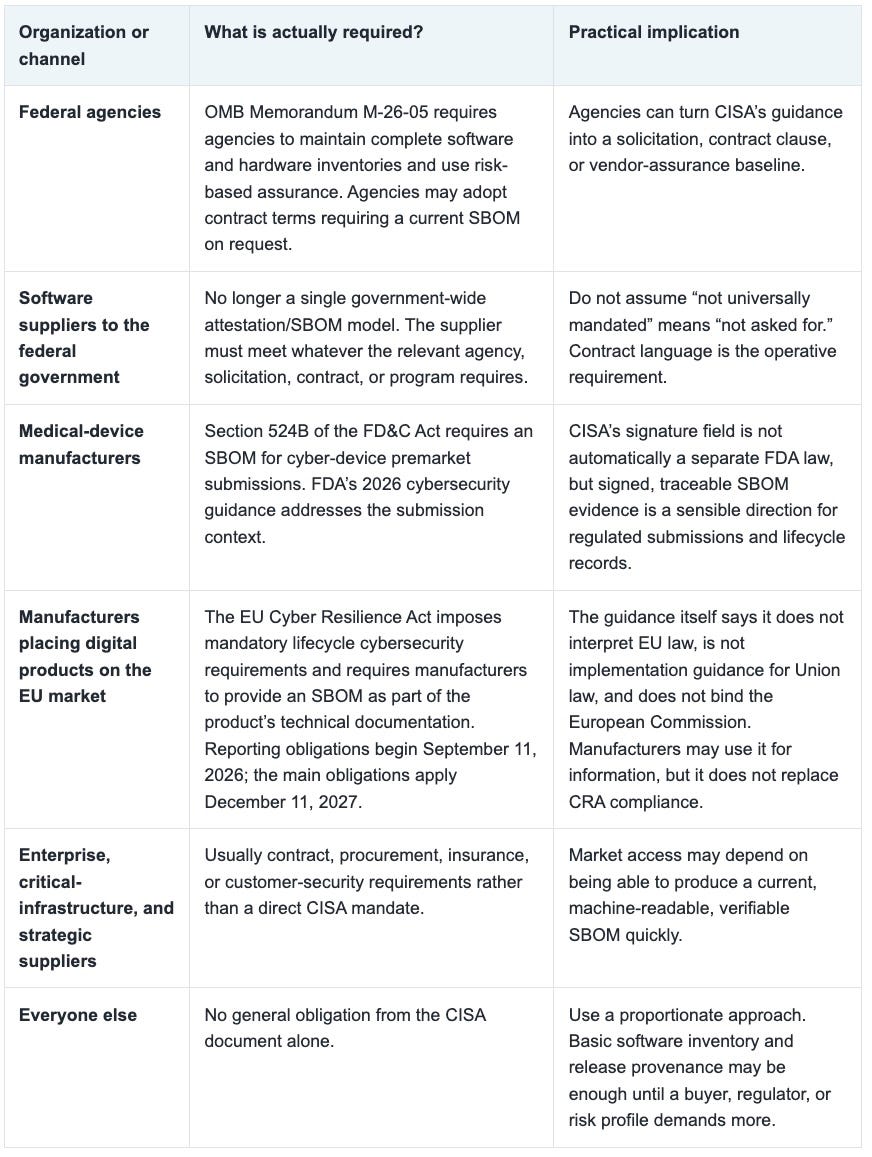
This distinction is especially important after OMB’s January 2026 M-26-05 memorandum. OMB rescinded the earlier standardized attestation memoranda and moved federal software and hardware assurance toward agency-specific, risk-based decisions. The result is not “SBOMs no longer matter.” The result is that the requirement is more likely to arrive through a specific agency, contract, sector, or customer relationship. In the EU, the CRA creates a separate legal obligation for in-scope manufacturers. The joint SBOM guidance can inform technical review, but the authoring organizations—and the European Commission’s own drafting note—say it is not EU-law implementation guidance.
What does a defensible implementation look like?
For an organization that decides the guidance applies to its market or risk profile, implementation should mean more than running an SBOM generator once a year. The owner is not just the team that produces the file. Someone must own the release boundary, the artifact identity, the signing key, the correction process, and the answer when a buyer asks whether the record is complete.
Define the release boundary. Decide whether the SBOM describes source, build output, container image, assembled product, deployed environment, or runtime production environment.
Generate at the right point in the pipeline. Create or update the SBOM for each release, update, material dependency change, and correction.
Use machine-readable formats. Accept and produce widely used, interoperable, machine-processable formats, including SPDX or CycloneDX, and preserve the original artifact. A buyer should not turn a format preference into an unnecessary barrier when an interoperable alternative satisfies the baseline.
Include the new trust metadata. Record the generation tool and version, generation context, hashes or equivalent identifiers, dependency relationships, coverage decisions, known unknowns, and digital signature. Use the signing infrastructure and key-management controls already protecting software releases where possible.
Bind the SBOM to the software. Sign the SBOM and tie it to the exact package, image, firmware, or runtime snapshot through a digest or equivalent provenance reference. The certificate or signature alone is not the binding.
Make verification routine. A customer or internal consumer should be able to verify the signature, signer identity, trust chain, artifact binding, timestamp, and status of the signing key without opening a support ticket.
Add vulnerability context. An SBOM is inventory. Use VEX, CSAF, or another defensible process to explain whether a listed vulnerability is actually exploitable or affects the product.
Test completeness independently. Compare the SBOM against software repositories, build outputs, and binary-analysis results to detect components that were not listed. A signature validates the document received; independent analysis tests whether the document reflects what shipped.
Retain evidence. Keep the build identifier, artifact hash, scan results, approval record, SBOM, signature, release log, and subsequent corrections together.
Do not confuse signing with truth
Signing proves origin and integrity of the document. It does not prove that the document contains every dependency, that the producer used a secure build system, or that a listed vulnerability is exploitable. Those require separate controls.
An SBOM only pays off when it drives remediation
Generating a signed SBOM with strong provenance is valuable, but it is still an inventory event. If the record is not coupled to a dynamic, near-real-time vulnerability posture management process and an ITSM-driven remediation workflow, much of the practical defense is left on the table.
The useful loop is not generate, sign, store. It is identify, correlate, prioritize, assign, remediate, verify, and update. When a new CVE appears—or when CISA adds a vulnerability to the Known Exploited Vulnerabilities Catalog—the organization should be able to identify which signed software versions contain the affected component, where those versions are deployed, who owns the exposure, what compensating control or patch is available, and when the fix must be complete.
That requires the SBOM to feed a live posture system that can normalize component identifiers, correlate them with CVEs, exploit intelligence, and VEX statements, and map them to actual assets and business services. The posture system then needs to create or update an ITSM record with an accountable owner, risk-based due date, change or emergency-change path, exception record, and evidence requirement. Closure should not mean that somebody checked a box. It should mean the deployed version was verified, the vulnerable component was removed or mitigated, and the SBOM and posture record now describe the same state.
This is also where an SBOM can provide negative assurance. If a newly reported vulnerability is tied to a component that the SBOM does not list, the recipient should be able to conclude that the vulnerability does not affect the software—provided the SBOM’s coverage and accuracy have been independently tested. Without that qualification, an absent component may mean “not present,” “not detected,” or “not documented.”
Near-real-time does not mean that every patch should be applied without testing. Safety-critical systems, regulated products, and production services need approval gates and rollback plans. It does mean that the time between vulnerability disclosure, exposure identification, ticket creation, remediation, and verification is measured and managed. Without that loop, a signed SBOM can become a highly trustworthy record of yesterday’s exposure.
NIST describes enterprise patch management as identifying, prioritizing, acquiring, installing, and verifying updates. CISA similarly positions the KEV Catalog as an input to vulnerability-management prioritization. The SBOM supplies the software identity; posture management and ITSM supply the operational response.
A brief note on protected signing keys
CISA does not require an HSM for every SBOM signature. The requirement depends on the market and the signing credential. For publicly trusted code signing, the CA/Browser Forum requires hardware- or cloud-HSM-backed protection for subscriber private keys. Federal, defense, payment, and qualified-signature environments may impose additional validated-cryptography, key-custody, or certification requirements.
An OpenSSL-based signature can be mathematically valid, but an exportable private key does not prove who controlled it or whether the signing event followed an authorized release process. For higher-risk software, use protected key custody, role separation, strong authentication, signing logs, artifact binding, and a documented revocation process. NIST’s point is important: an approved algorithm is not the same thing as a validated cryptographic module.
One hosted example is DigiCert Software Trust Manager operating through DigiCert ONE. DigiCert’s published materials describe FIPS 140-2 Level 3 or Common Criteria EAL4+ HSM key storage, protected private keys during supported signing workflows, and audit logs identifying what was signed, by whom, and when. Its July 2026 release notes state that code-signing keys support FIPS 140-3. Buyers should request the current CMVP certificate and service-specific attestation before making a compliance claim. The joint guidance is vendor-neutral; enterprise HSM-backed services, private modules, and keyless approaches such as Sigstore may fit different trust and procurement models, but they are not interchangeable in every regulated environment.
Disclosure: DigiCert is my employer. The example is included as a reference architecture; organizations should validate the current module, scope, and attestations against their own requirements.
Who should move toward compliance now?
Not every software producer needs the same program. The sensible question is not, “Can we claim CISA compliance?” It is, “Where will the absence of verifiable software composition evidence block revenue, increase liability, or slow incident response?”
Move now
Software and cloud vendors selling to federal agencies or federal prime contractors.
Manufacturers of connected devices, embedded systems, industrial products, and firmware distributed into the EU or other regulated markets.
Medical-device companies preparing cyber-device submissions or maintaining products with significant software exposure.
Vendors whose enterprise customers already request SBOMs, provenance, signed releases, or supply-chain attestations.
Organizations shipping software that can affect safety, critical infrastructure, financial operations, healthcare, or identity.
Software producers with a mature code-signing process that can add SBOM signing without rebuilding the entire delivery system.
Prepare in proportion
B2B SaaS companies that are not yet receiving SBOM requests but sell into larger security-conscious buyers.
Open-source maintainers whose projects are embedded in commercial products or critical infrastructure.
Internal enterprise development teams that operate software used in regulated or high-impact workflows.
AI product teams that need to track models, datasets, infrastructure, and software dependencies. The separate G7/CISA AI-SBOM guidance was issued in May 2026; this document’s minimum elements do not themselves add AI-specific fields.
Do not overbuild yet
Small teams building noncommercial, low-risk software with no external distribution or regulated use.
Companies with no buyer, contract, regulator, or material risk signal that would use a signed SBOM.
Organizations tempted to buy a large compliance platform before they can identify which artifacts they ship and who owns the release process.
“Do not overbuild” does not mean “do nothing.” A lightweight SBOM generated at build time, stored with the release, and linked to an artifact digest is often a better first move than a large compliance project. The inventory is the first move; the destination is a repeatable release and verification process.
The broad market-access implications
1. The SBOM becomes a procurement credential
The practical effect of guidance is often indirect. A procurement team copies it into a questionnaire. A prime contractor turns it into a flow-down requirement. A security assessor asks for evidence. An insurer asks how software provenance is controlled.
That is how a voluntary baseline becomes a market gate. The seller may never receive a letter from CISA. The seller may simply fail to get through the buyer’s security review.
2. Software trust moves from “provided” to “verifiable”
Unsigned SBOMs are easy to email and difficult to trust. A signed SBOM creates a basis for automated intake: verify the signer, verify the artifact binding, check freshness, ingest the component graph, and route exceptions.
This will favor vendors with governed release pipelines, protected signing keys, stable artifact identity, and evidence retention. It will disadvantage vendors whose SBOM process lives in a spreadsheet, a ticket, or a developer’s laptop.
3. Smaller suppliers face a higher cost of entry
The cost is not just generating an SBOM. It includes identifying transitive dependencies, handling proprietary components, deciding what “coverage” means, protecting signing keys, maintaining trust relationships, correcting errors, and responding to buyer questions.
Large vendors can absorb this cost more easily. Smaller vendors may experience it as a new barrier to enterprise and government markets. That creates a real policy tradeoff: better transparency can improve security while also concentrating market access among suppliers with stronger operational maturity.
4. New assurance markets will grow around the gap
Expect demand for SBOM generation, artifact signing, key custody, provenance, verification, software supply-chain assessments, managed evidence repositories, and customer-facing trust portals. The winning products will not merely create a file. They will connect software composition to release authorization, vulnerability management, incident response, and procurement evidence.
5. Interoperability and data quality become commercial issues
CISA’s framework does not eliminate the hard questions: which format, which identifiers, what is complete enough, how are proprietary dependencies represented, and how does a consumer compare one vendor’s SBOM with another’s?
Buyers will increasingly need measurable acceptance criteria. “SBOM attached” is not enough. They will ask whether the file is machine-readable, current, signed, tied to the delivered artifact, sufficiently covered, and usable in the buyer’s vulnerability-management system.
The strategic takeaway
CISA’s July 2026 guidance should not be read as a universal command to launch a massive compliance program. It should be read as a signal about where software assurance is heading—and as a test of whether a software producer can answer basic questions about its own releases.
For the highest-risk and highest-value software, the market is moving toward a simple expectation:
Tell me what is in the software. Show me how you know. Let me verify that the record belongs to the artifact I received.
Companies selling into government, healthcare, critical infrastructure, connected products, the EU, or large enterprise procurement should move toward that standard now. Companies outside those channels can sequence the work, beginning with release inventory and artifact identity.
The mistake is not failing to become “CISA compliant” overnight. There is no universal certification to obtain. The mistake is waiting until a buyer, regulator, incident, or contract makes verifiable software composition evidence a condition of doing business.
About the author
Tim McAllister is a Regional Field CTO in DigiCert’s Office of the CTO. He works with enterprises and original equipment manufacturers on digital trust, PKI, device identity, software signing, Cyber Resilience Act readiness, and post-quantum migration—particularly where a policy requirement becomes an engineering and operating problem.
Tim contributes to standards and industry initiatives involving NIST, SAE EVPKI, Matter, and CharIN. He writes about the practical use of digital trust and trusted AI, including the controls, ownership models, and market decisions required to move from technical guidance to defensible operation.
Sources and reading
CISA, NSA, FBI, and international authoring organizations: 2026 Minimum Elements for a Software Bill of Materials, Version 2.1, published July 29, 2026
Dark Reading: CISA Issues Fresh SBOM Guidance. Did They Get It Right?, July 31, 2026
OMB Memorandum M-26-05: Adopting a Risk-based Approach to Software and Hardware Security
NIST: FIPS 140-3, Security Requirements for Cryptographic Modules
NIST SP 800-57 Part 1 Rev. 5: Recommendation for Key Management
DigiCert Software Trust Manager and Software Trust Manager signing documentation
NIST SP 800-40 Rev. 4: Guide to Enterprise Patch Management Planning
1 The guidance’s scope section states: “The minimum elements do not create new requirements; they refine how organizations should generate and request SBOMs.” 2026 Minimum Elements for a Software Bill of Materials, p. 7.
This article is an analysis of public guidance and market implications, not legal advice. Organizations should map their specific obligations to contracts, procurement terms, sector rules, and applicable law.